In 1995, while visiting my sister in Zambia, I was given the use of a car. That gave me the freedom to explore—and, as so often during my travels in Africa, to ask people a question that had become something of a habit:
“Do you know of any interesting uses of insects or other small creatures?”
One of my trips took me to Choma, a town about 300 kilometres southwest of Lusaka and some 200 kilometres from Livingstone and the Victoria Falls. There I visited the Choma Museum, which focuses on the history and culture of Zambia’s Southern Province.
I put my usual question to the curator.
She thought for a moment.
“Yes,” she said. “There is something. But I don’t know much about it. You should talk to a priest who lives about 50 kilometres from here.”
That was enough to make me curious. So I got back into the car and set off to find him.
Fortunately, he was at home. He welcomed me in, offered me tea, and then told me something I had certainly not expected..
It was about spiders and music
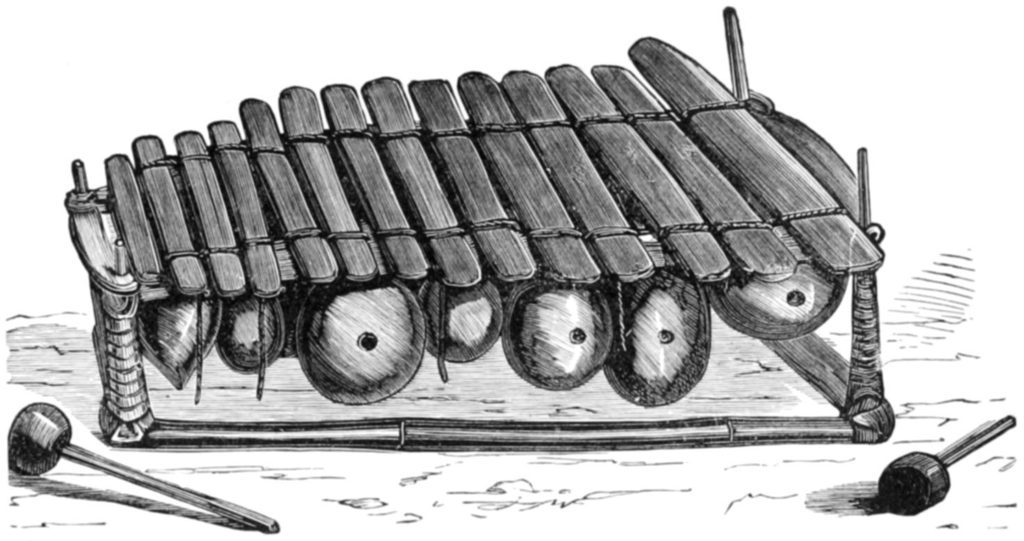
A spider web inside a xylophone.
The priest explained that the dense webs made by small spiders on the walls of houses could be collected and used in traditional xylophones.
At first, this seemed rather extraordinary. What could a spider possibly have to do with a musical instrument?
The answer lies underneath the wooden keys.
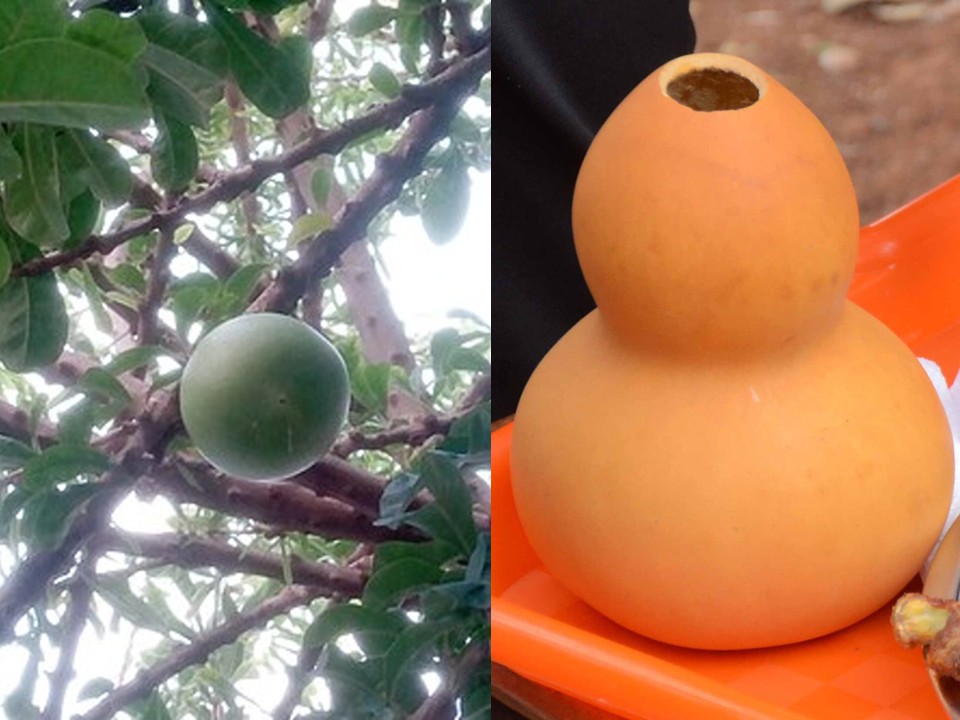
Many traditional African xylophones have dried calabashes suspended beneath them. A calabash is the hardened shell of a bottle gourd. When the fruit is allowed to mature and dry, its shell becomes hard, light and durable. For centuries, these gourds have been turned into bowls, containers—and musical instruments.
In a xylophone, the hollow calabashes act as resonators, amplifying and enriching the sound of the wooden keys above them. But there is another ingenious addition. A small opening is made in the calabash and covered with a thin membrane. When the instrument is played, the membrane vibrates, giving the note a characteristic buzzing or humming quality (see and hear now).
And the membrane can be made from spider web.
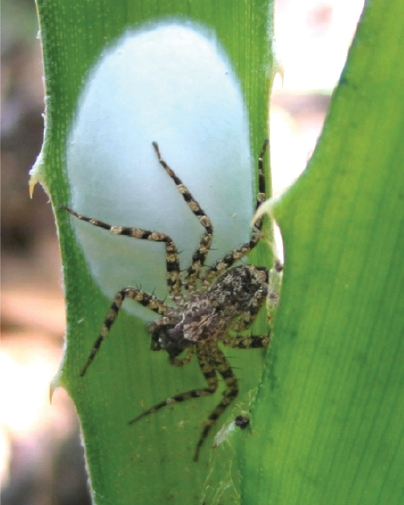
Fig. S3. Selenops sp.. protecting the silken egg sac.Fig. S4. A xylophone with the dried calabashes underneath.
Similar stories from other parts of Africa
I later discovered that the priest’s story was far from unique.
During my own interviews elsewhere in sub-Saharan Africa, I repeatedly heard similar stories about xylophones and balafons.
What I had first heard over a cup of tea from a priest in rural Zambia turned out to be part of a much wider musical tradition.
An old account from Zambia, D. W. Stirke’s Barotseland: Eight Years among the Barotse, describes a xylophone known as the silimba. Beneath its wooden keys are calabash resonators. Stirke noted that each calabash had a small opening covered with spider web, which affected the vibration of the notes.
What fascinated me even more was that similar practices occur far beyond Zambia.
In northwestern Ghana, Hogan (2015), in Enemy Music: Blind Birifor Xylophonists of Northwest Ghana, describes dense spider-web membranes being placed on the resonating gourds of xylophones.
The same principle has been documented in Malawi. Daur and Kubik (1977), writing about the music of Daniel Kachamba, describe the ulimba, a xylophone used by the Sena people of southern Malawi. A rectangular opening is cut into each resonating gourd and covered with spider web.
A spider web, a papaya plant—a flute
But xylophones were not the end of the story.
People also told me that children could use spider webs to make their own musical instruments.
The ingredients could hardly be simpler: a hollow plant stem and a piece of spider web.
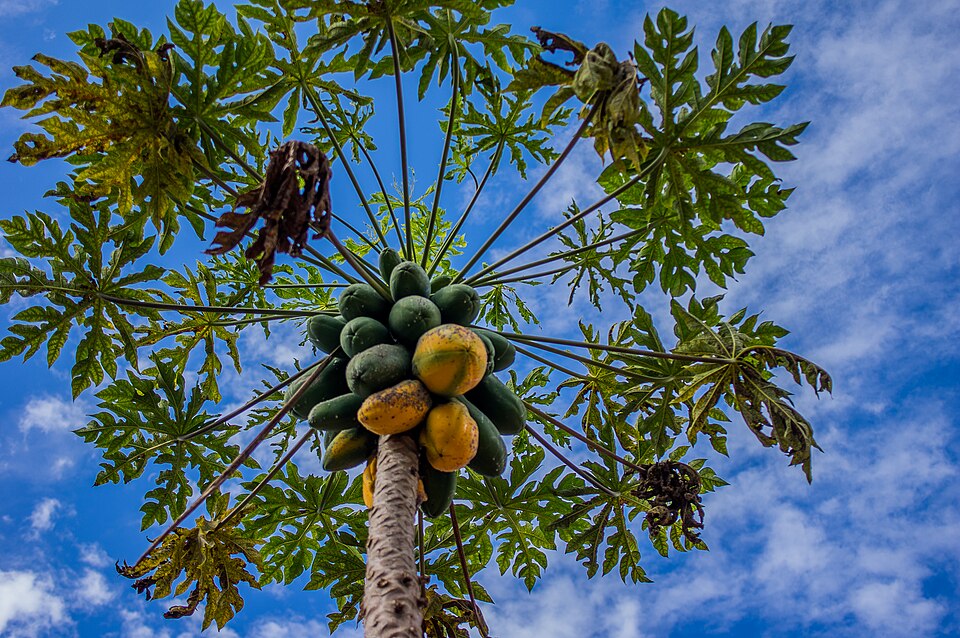
Fig. S 5. The papaya plant of which the stalks of the leaves are used.
The stalk of a papaya leaf is particularly useful because it is naturally hollow, although a piece of reed can serve the same purpose. One end of the tube is covered with spider web, and the child blows through the other. The web vibrates and changes the sound. Holes can even be made along the tube so that different notes can be produced, turning this simple object into a kind of homemade flute. But from Zambia there the horn of a sable antelope is also used as a flute by making a hole in it and covering it with a membrane (read here).
A calabash can be used in much the same way.
It is a wonderful example of how musical instruments can emerge from materials found almost literally on one’s doorstep: a plant growing beside the house, a dried gourd—and a spider quietly spinning its web on the wall.
The remarkable calabash
The calabash itself deserves a special mention because it is one of nature’s great musical building materials.
Across Africa, dried gourds have been incorporated into an astonishing variety of instruments. They serve as resonators beneath the wooden keys of balafons, form the body of stringed instruments such as the n’goni and bolon, and become percussion instruments such as the shekere, where the gourd is surrounded by a net of beads or shells.
Fig. S 6. The gourds of the Calabash vine or the Calabash tree: left the fruit and right the dried fruit.
People discovered long ago what modern acoustics can explain scientifically: a hollow chamber can amplify and modify sound.
But then came another discovery. Add a delicate vibrating membrane over an opening in that chamber, and the sound changes again.
For that membrane, people made use of something that was already available in their homes.
A spider’s web.
Listening differently to a spider
We normally think of spider webs as traps. Their purpose is to catch insects, and when we find one in a corner of the house, our first impulse may be to sweep it away.
But the stories I encountered in Africa taught me to look at them differently.
A spider web can be more than a hunting device. In human hands, it can become part of a musical instrument.
What strikes me most is the ingenuity behind this. Long before anyone could explain the physics of vibrating membranes, people had discovered through observation and experimentation that a material produced by a tiny animal could transform the sound of an instrument.
And that is why I still remember that unexpected journey from Choma.
I had driven 50 kilometres to ask a priest about insects.
Instead, over a cup of tea, I discovered that spiders can help make music.
Which Spider Makes Silk Fit for a Musical Instrument?
What kind of spider produces silk suitable for a musical instrument?
This question is more intriguing than it might first appear. In several parts of Africa, spider silk has traditionally been used to cover small openings in the resonators of xylophones such as the balafon and silimba. When the instrument is played, this delicate membrane vibrates, producing the characteristic buzzing or humming sound that gives the instrument its distinctive voice.
But which spider provides the right kind of silk?
After further investigation, it seems that the material used may not be ordinary spider webbing at all. Instead, it may be the dense silk that spiders produce to protect their egg sacs. Such silk has exactly the qualities needed: it is thin and light, yet sufficiently strong and coherent to form a vibrating membrane.
Three groups of spiders seem particularly interesting candidates
1. Oecobius — tiny spiders living on walls
Small spiders of the genus Oecobius are commonly associated with walls, rocks, cracks and corners. They produce fine, densely woven patches of silk on these surfaces.
This silk is particularly interesting because its structure appears suitable for the membrane of a balafon resonator: light enough to vibrate freely, but sufficiently dense and strong not to tear immediately.
For West Africa, Oecobius is therefore an intriguing candidate.
2. Selenopidae — the remarkably flat wall spiders
Another possibility is the family Selenopidae, commonly known as wall crab spiders or “flatties.”
These spiders (Fig. S3) have extraordinarily flattened bodies and are perfectly adapted to living on vertical surfaces. They can be found on rock faces, tree trunks, beneath bark and in narrow crevices. Their egg sacs are attached to surfaces and protected by silk.
This makes the group especially interesting in relation to reports from Zambia, where I was told that suitable spider silk could be collected from the walls of houses and used on the resonators of the silimba.
Selenopid spiders may therefore be a promising candidate for southern Africa.
3. Holcolaetis — another possibility
A third candidate is Holcolaetis, a genus of African jumping spiders. Some species live on tree trunks and other flat surfaces and produce flat, densely woven silken retreats or egg sacs.
The dense nature of this silk makes Holcolaetis another possibility worth investigating.
A small mystery still waiting to be solved
At present, we cannot say with certainty which spider—or perhaps which different spiders in different parts of Africa—provides the silk traditionally used for these musical instruments.
That possibility is particularly fascinating. Musicians may simply have learned to recognize the right kind of silk, rather than a particular spider species. Wherever they lived, they could collect a thin, strong sheet of spider silk from walls, trees or other surfaces and transform it into part of an instrument.
It is a remarkable meeting of spider biology, traditional knowledge and music. A material originally produced to protect a spider’s offspring may have acquired an entirely different function in human hands: helping to give an African musical instrument its characteristic sound.
The spider behind that sound, however, remains something of a mystery.
In 1995, I took a three-month sabbatical with an unusual objective: I wanted to discover how people in sub-Saharan Africa used insects and other arthropods in their everyday lives.
I was interested not only in insects as food or medicine, but also in their place in religion and witchcraft, art and music, dance, children’s games, stories, and proverbs. Together with a second sabbatical in 2000, this journey eventually led me to interview 304 people from 121 ethnic groups in 27 African countries.