Lutte biologique contre Callosobruchus maculatus – un ravageur du niébé en entrepôt – à l'aide du parasitoïde des œufs Uscana lariophaga
Présentation générale
Le Nigeria et le Niger produisent plus de la moitié de la production mondiale de niébé, une légumineuse très nutritive souvent surnommée « la viande des pauvres » en raison de sa richesse en protéines, en fer et en vitamines. Le niébé revêt une importance particulière en Afrique de l'Ouest, où il constitue une source de nutrition abordable pour des millions de personnes.
Cependant, les agriculteurs sont confrontés à un problème majeur après la récolte : un minuscule coléoptère appelé Callosobruchus maculatus (le charançon du niébé). Même une infestation mineure dans les champs peut prendre des proportions gigantesques pendant le stockage, détruisant jusqu’à 80 % des graines stockées en l’espace de six à huit mois.
Il s'agit d'un problème grave, car les agriculteurs stockent généralement les niébés pour les vendre plus tard, lorsque les prix augmentent — ceux-ci doublant souvent avant la prochaine saison des pluies. Malheureusement, des dégâts importants causés par les coléoptères peuvent anéantir ces bénéfices potentiels.
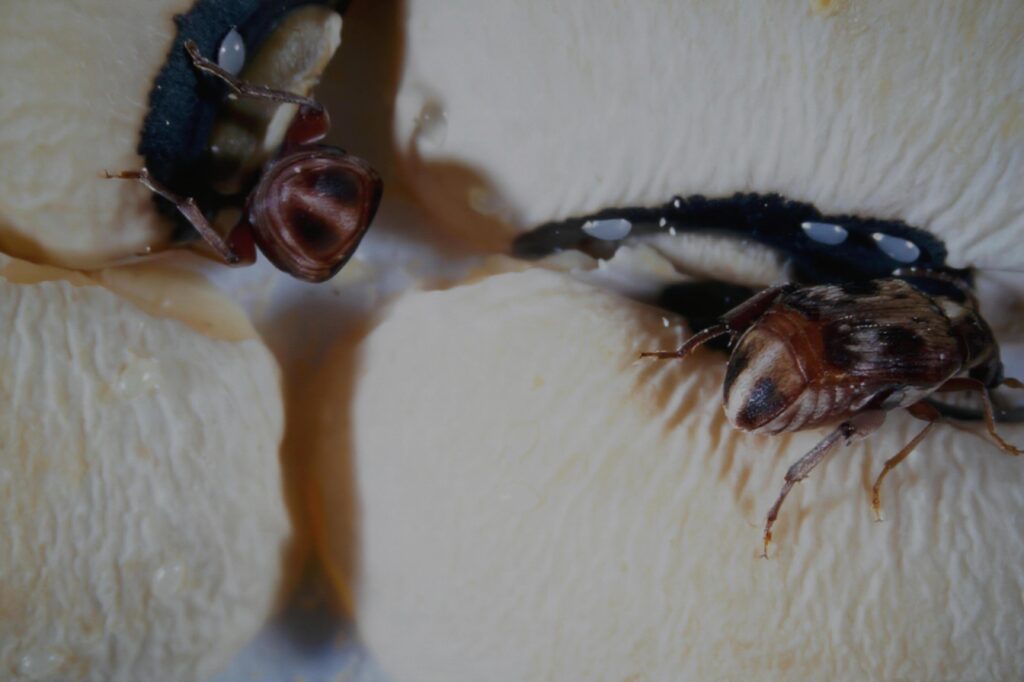
De nombreux agriculteurs ont recours à des méthodes traditionnelles de conservation, telles que les extraits végétaux, les huiles, le sable ou la cendre, pour protéger leurs cultures, mais ces méthodes ne sont pas toujours efficaces. Les pesticides chimiques sont souvent trop chers ou difficiles à se procurer.
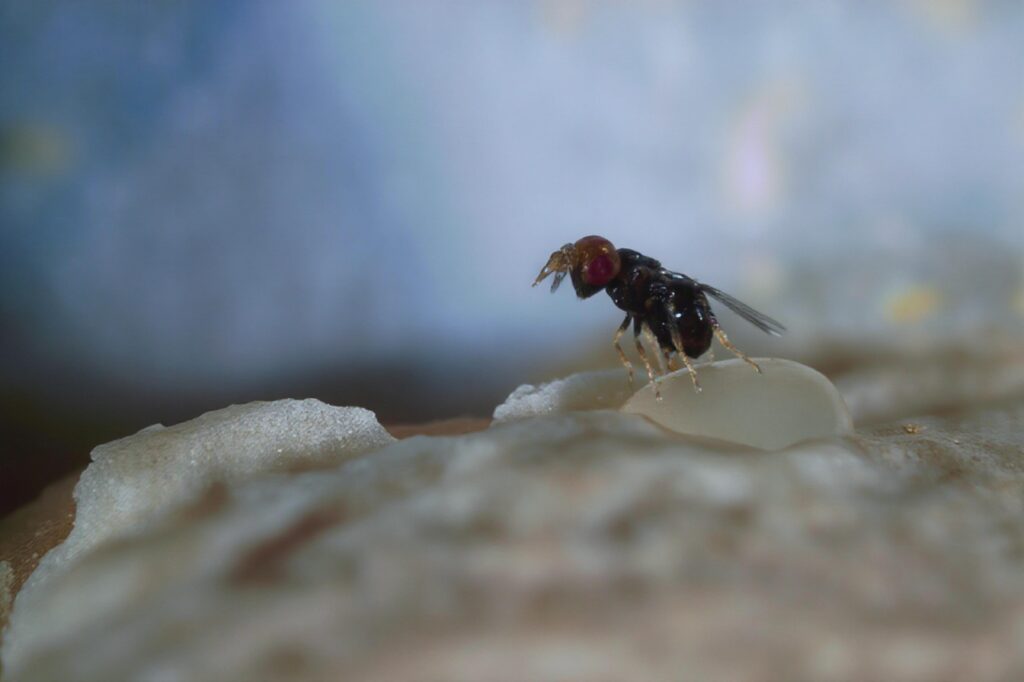
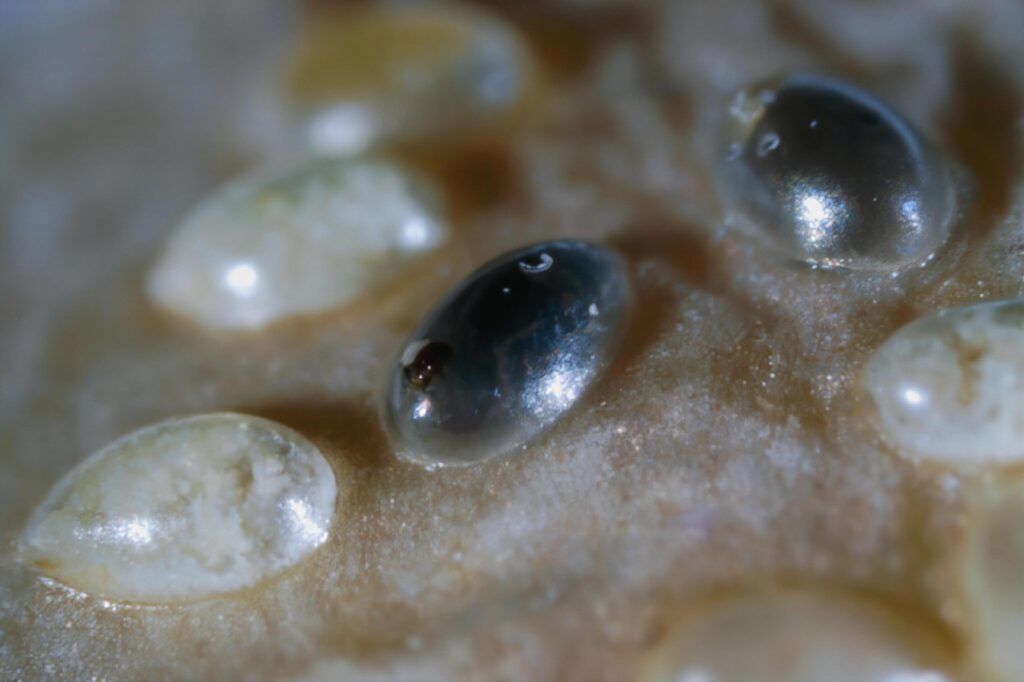
Les chercheurs explorent donc une solution naturelle : l'utilisation d'insectes utiles qui s'attaquent aux coléoptères. Au Niger, une minuscule guêpe parasite, l'Uscana lariophaga, pond ses œufs dans ceux des coléoptères, ce qui les tue. Des études montrent que l'Uscana lariophaga peut réduire considérablement les niveaux d'infestation.
Nous avons étudié l'impact du parasitoïde des œufs sur les populations de bruchides. En comprenant le mode d'action de ce parasitoïde, nous espérons mettre au point des méthodes biologiques abordables pour protéger le niébé stocké et aider les agriculteurs à réduire leurs pertes.
PhD students supervised
- Boeke, S.J., 2002. Traditional African plant products to protect stored cowpeas against insect damage; the battle against the beetle. Supervision with Prof. M. Dicke and Prof. J. van Loon. Award date12 November 2002. Promotion date: https://doi.org/10.18174/192258
- Stolk, C., 2002. Spatial and behavioural aspects of foraging by Uscana lariophaga, egg parasitoid of Callosobruchus maculates, in stored cowpea. Supervision with Prof. J.C van Lenteren. Promotion date: 10 December 1996. https://edepot.wur.nl/202236
- F.A.N. van Alebeek, 1996. Foraging behaviour of the egg parasitoid Uscana lariophaga. Promotion with Prof. J.C. van Lenteren. Promotion date: 13 Juni 1997. https://edepot.wur.nl/210627
Publications
Refereed
- Alebeek, F.A.N. van, K.K. Antwi, A. van Huis, J.C. van Lenteren, 2007. Dispersal and functional response of Uscana lariophaga in two different habitats: stored cowpea pods and seeds. Bulletin of Insectology, 60 (1): 63-70.
- Spitzen, J., and A. van Huis, 2005. Effect of host quality of Callosobruchus maculatus (Coleoptera: Bruchidae) performance of the egg parasitoid lariophaga (Hymenoptera: Trichogrammatidae). Bulletin of Entomological Research, 95, 341–347.
- Stolk, C., M.N. Ghimire, S. Souquié, W. van der Werf, and A. van Huis, 2005. Host finding by Uscana lariophaga in stored cowpea: the effect of distance, time interval, host patch size and spatial orientation. Bulletin of Entomological Research, 95: 231-241.
- Boeke, S.J., J.J.A. van Loon, A. van Huis, M. Dicke, 2004. Host preference of Callosobruchus maculatus: a comparison of life history characteristics for three strains of beetles on two varieties of cowpea. Journal of Applied Entomology, 128(6): 390-396.
- Boeke, S.J., C. Barnaud,.J.J.A. van Loon, D.K. Kossou, A. van Huis, and M. Dicke, 2004. Efficacy of plant extracts against the cowpea beetle, Callosobruchus maculatus. International Journal of Pest Management 50, 251-258.
- Boeke, S.J., M.G. Boersma, G.M. Alink, J.J.A. van Loon, A. van Huis, M. Dicke, and I.M.C.M. Rietjens, 2004. Safety evaluation of neem (Azadirachta indica) derived pesticides. Journal of Ethnopharmacology, 94: 25–41.
- Boeke, S.J., D.K. Kossou, A. van Huis, J.J.A. van Loon, and M. Dicke, 2004. Field trials with plant products to protect stored cowpea against insect damage. International Journal of Pest Management 50: 1-9.
- Boeke, S.J., I.R. Baumgart, J.J.A. van Loon, A. van Huis, M. Dicke, and D.K. Kossou, 2004. Toxicity and repellence of African plants traditionally used for the protection of stored cowpea against Callosobruchus maculatus. Journal of Stored Products Research, 40: 423-438.
- Kossou, D., A Ahanchede, A. van Huis, A.C. Sinzogan and D. Djidonou, 2003. Analyse de l’agroécosystème: un outil pour la formulation des composantes d’une lutte intégrée contre les ravageurs du niébé (Vigna unguiculata L. (Walp.)) dans la vallée de l’Ouémé au sud du bénin. Annales des Sciences Agronomiques, 5(2). http://dx.doi.org/10.4314/asab.v5i2.43368.
- Van Huis, A, F.A.N van Alebeek, M. van Es, and S.B. Sagnia, 2002. Impact of the egg parasitoid Uscana lariophaga and the larval‑pupal parasitoid Dinarmus basalis on Callosobruchus maculatus populations and cowpea losses. Entomologia Experimentalis et Applicata, 104: 289-297.
- Boeke, S.J., J.J.A. van Loon, A. van Huis, D.K. Kossou, and M. Dicke, 2001. The use of plant material to protect stored leguminous seeds against seed beetles: a review. Wageningen University Papers. 2001-3. 108 pp.
- Kossou, K.D., G. Gbèhounou, A. Ahanchédé, B. Ahohuendo, Y. Bouraïma, and A. van Huis, 2001. Indigenous cowpea production and protection practices in Benin. Insect Science and its Application, 21(2): 123-132.
- Stolk, C., A. Stein, S.B. Slumpa, S.K. Tiase, and A. van Huis, 2001. Exploring the foraging environment of a natural enemy of Callosobruchus maculatus: Spatial egg distribution in stored cowpea. Entomologia Experimentalis et Applicata, 101: 167 ‑ 181.
- Alebeek F.A.N. van, Kwaku Kyei Antwi, A. van Huis, and J.C. van Lenteren, 1998. Dispersal and functional response of Uscana lariophaga in two different habitats: stored cowpea pods and seeds. Submitted to Entomologia Experimentalis et Applicata.
- Van Huis, A, and M. de Rooy, 1998. The effect of leguminous plant species on Callosobruchus maculatus (Coleoptera: Bruchidae) and its egg parasitoid Uscana lariophaga (Hymenoptera: Trichogrammatidae). Bulletin of Entomological Research, 88: 93-99.
- Van Huis, A, C. Schütte, and S. Sagnia, 1998. The impact of the egg parasitoid Uscana lariophaga (Hymenoptera: Trichogrammatidae) on Callosobruchus maculatus (Coleoptera: Bruchidae) and the damage to cowpea in a traditional storage system. Entomologia Experimentalis et Applicata, 89: 289-295.
- Alebeek, F.A.N. van, and A. van Huis, 1997. Host location in stored cowpea by the egg parasitoid Uscana lariophaga (Hym., Trichogrammatidae). Journal of Applied Entomology, 121: 399-405.
- Alebeek, F.A.N. van, C.M. Koning, E.A.P. de Korte, and A. van Huis, 1996. Egg limited functional response of Uscana lariophaga, egg parasitoid of bruchid beetle pests in stored cowpea. Entomologia Experimentalis et Applicata, 81: 215-225.
- Alebeek, F.A.N. van, T.M. Bezemer, A. van Huis, and J.C. van Lenteren, 1996. The functional response of Uscana lariophaga Steffan under different egg distributions of its host Callosobruchus maculatus. Entomologia Experimentalis et Applicata, 81: 227-233.
- Van Huis, A, and S.O. Appiah, 1995. Uscana lariophaga, West-African egg parasitoid of the cowpea bruchid beetle Callosobruchus maculatus: photoperiod, parasitization and eclosion interactions. Entomologia Experimentalis et Applicata, 76: 1-6.
- Van Huis, A, P.W. Arendse, M. Schilthuizen, P.P. Wiegers, H. Heering, M. Hulshof, and N.K. Kaashoek, 1994. Uscana lariophaga egg parasitoid of bruchid beetle storage pests of cowpea in West Africa: the effect of temperature and humidity. Entomologia Experimentalis et Applicata, 70: 41-53.
- Van Huis, A, 1991. Biological methods of bruchid control in the tropics: a review. Insect Science and its Application, 12: 87-102.
- Van Huis, A, M.G. Wijkamp, P.M. Lammers, and C.G.M. Klein Goldewijk, J.H. van Seeters and N.K. Kaashoek, 1991. Uscana lariophaga (Hymenoptera: Trichogrammatidae), an egg parasitoid of bruchid beetle (Coleoptera: Bruchidae) storage pests in West Africa: host-age and host-species selection. Bulletin of Entomological Research, 81: 65-75.
Non-refereed
- Stolk, C., W. van der Werf, and A. van Huis, 2002. Bugs in space: aspects of the system Callosobruchus maculatus (Col.: Bruchidae) and Uscana lariophaga (Hym.: Trichogrammatidae) in stored cowpea. In: Integrated Protection in Stored Products (Eds.: C. Adler, S. Navarro, M. Schoeller, and L. Stengard‑Hansen). IOBC wprs Bulletin, 25: 141‑144.
- Boeke, S.J., I. R. Baumgart, J.J. A. van Loon, A. van Huis, D.K. Kossou, and Marcel Dicke, 2000. The battle against the beetle: toxic and repellent effects of African plants against the cowpea beetle, Callosobruchus maculatus. Poster Graduate School “Production Ecology and Resource Conservation”. Wageningen University.
- Stolk, C., W. van der Werf, and A. van Huis, 1999. Models of stored-product pests: their application to biological control in traditional storage in developing countries. In: Z. Jin, Q. Liang, Y. Liang, X. Tan & L. Guan (eds), Stored Product Protection: Proceedings of the 7th International Working Conference on Stored Product Protection, 14‑19 October 1998, Beijing, P.R. China. Sichuan Publishing House of Science and Technology, Chengdu, Sichuan, P.R. China, Vol. 1, pp. 72-87.
- Van Huis, A, C. Schütte, M.H. Cools, Ph. Fanget, H. van der Hoek, and S.P. Piquet, 1994. The role of semiochemicals in host location by Uscana lariophaga, egg parasitoid of Callosobruchus maculatus. Conference Handbook 6th International Working Conference on Stored-product protection, 17-23 April 1994. Canberra, Australia. Nr. 254, p. 107.
- Van Huis, A, C. Schütte, M.H. Cools, Ph. Fanget, H. van der Hoek, and S.P. Piquet, 1994b. The role of semiochemicals in host location by Uscana lariophaga, egg parasitoid of Callosobruchus maculatus. In: E. Highley, E.J. Wright & H.J. Banks (eds.), Proceedings 6th International Working Conference on Stored-product protection, April 17-23, 1994, Canberra, Australia, Vol. 2, pp. 1158-1164.
- Van Huis, A, P.W. Arendse, M. Schilthuizen, P.P. Wiegers, and N.K. Kaashoek, 1991. Uscana lariophaga (Hym.: Trichogrammatidae), egg parasitoid of Callosobruchus maculatus (Col.: Bruchidae) stored product pest of cowpea in West Africa.: the effect of temperature on parasitization. International Conference on Biological Control in Tropical Agriculture “Biological control towards a safer environment”, 27-30 August, 1991, Malaysia.
- Van Huis, A, N.K. Kaashoek, and H.M. Maes, 1991. Biological control of bruchids (Col.: Bruchidae) in stored pulses by using egg parasitoids of the genus Uscana (Hym.: Trichogrammatidae): a review. In: Proceedings of the First International Working Conference on stored-product protection (Eds.: F. Fleurat-Lessard and P. Ducom), 2: 99-108. September 9-14, 1990, Bordeaux, France.
- Van Huis, A, P.W. Arendse, M. Schilthuizen, P.P. Wiegers, and N.K. Kaashoek, 1991. Uscana lariophaga (Hym.: Trichogrammatidae), egg parasitoid of Callosobruchus maculatus (Col.: Bruchidae) stored product pest of cowpea in West Africa.: the effect of temperature on parasitization. International Conference on Biological Control in Tropical Agriculture “Biological control towards a safer environment”, 27-30 August, 1991, Malaysia.
- Van Huis, A, N.K. Kaashoek, and P.M. Lammers, 1990. Uscana lariophaga (Hym.: Trichogrammatidae), egg parasitoid of two bruchid species of cowpea in West Africa. Proceedings Experimental and Applied Entomology, N.E.V. Amsterdam, 1:101-106.
- Lammers, P.M., and A. van Huis, 1989. Uscana lariophaga Steffan (Hym.: Trichogrammatidae), egg parasitoid of the stored insect pests Callosobruchus maculatus (F.) and Bruchidius atrolineatus Pic. (Col.: Bruchidae): population studies in the field and in storage in Niger. Proceedings international conference on integrated pest management in tropical and subtropical ecosystems, 3: 1013-1022. 8-15 February 1989. Bad Dürkheim, West Germany.
- Van Huis, A, and N.K. Kaashoek, 1989. Uscana lariophaga, egg parasite of bruchids in cowpea in West Africa. Abstracts second international symposium on bruchids and legumes, Annex 2, p. 47 of the Japanese Society of Applied Entomology and Zoology, Foundation for advancement of International Science. 6-9 September 1989. Okayama, Japan. 117 pp.
- Van Huis, A, 1992. Biological control of bruchids in stored pulses by using egg parasitoids of the genus Uscana. 37th spring meeting of the Entomological Society of the Netherlands (NEV), 25 april, Utrecht.