
CONTENTS
I thought I knew grasshoppers. The women of Niger knew better
Introduction
The travels produced many remarkable stories. But one of the most important came right at the beginning, in Niger. It was a conversation that would eventually change the direction of my career.
Niger was a natural place for me to start. From 1982 to 1985, I had lived and worked there, coordinating a large training programme in crop protection for countries across the Sahel. Returning ten years later meant that I still knew people in the country, including staff at the Plant Protection Service.
I also had access to students from different Sahelian countries. Because they had agricultural backgrounds, it was relatively easy to talk with them about insects. Or so I thought.
Then, during one interview at the Plant Protection Service, someone casually told me something that stopped me in my tracks.
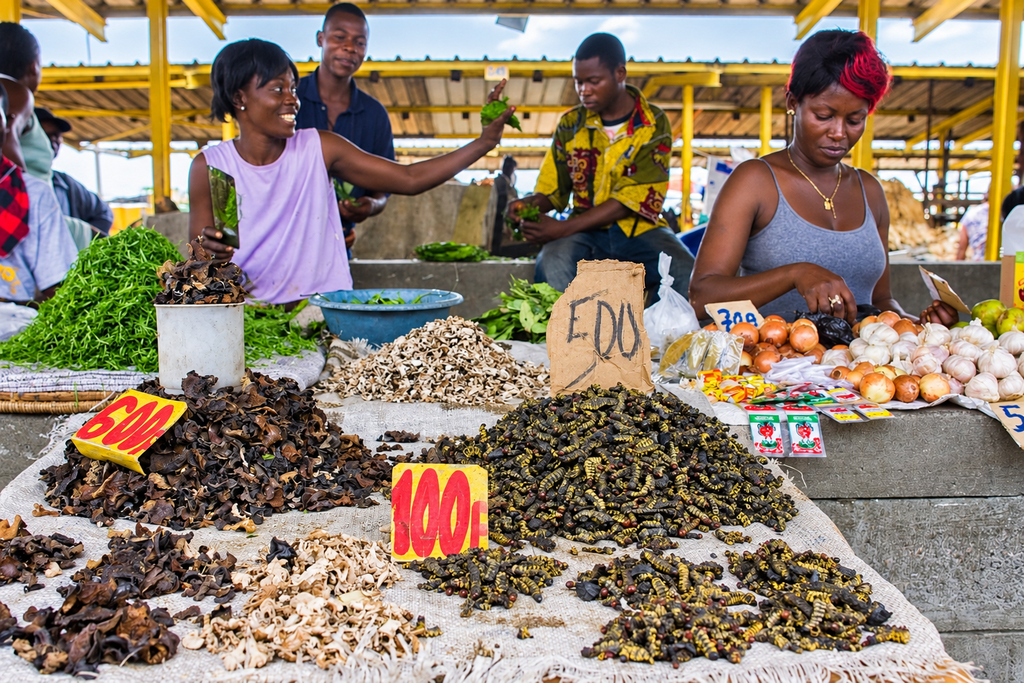
“Women farmers earn more money by selling grasshoppers collected from their millet fields than by selling the millet itself.”
I was flabbergasted.
I had lived and worked in Niger for three years. My profession was entomology. I had been involved in crop protection. Grasshoppers were hardly unfamiliar to me.
And yet I had never heard about this.
How could I have missed something so important?
The blind spot
At first, I felt embarrassed. But gradually I began to understand that the problem went much deeper than simply overlooking a fact.
Eating insects was often regarded in the West as primitive or backward. Africans were well aware of that attitude. Why would people voluntarily discuss such practices with a Western scientist if they expected to be ridiculed or looked down upon?
And there was another problem: I had never seriously asked.
That realization taught me an important lesson. You can spend years in another country, work closely with local people, and even consider yourself knowledgeable about their lives—and still fail to see what is right in front of you. Your own cultural assumptions can determine which questions you ask and, therefore, which answers you receive.
It made me much more cautious about assuming that I understood another culture.
A new question in every interview
From then on, I deliberately asked people about eating insects. More importantly, I showed that I was genuinely interested in their answers.
The effect was remarkable.
In many of my subsequent interviews across Africa, edible insects occupied as much as half of the conversation. People told me which species they collected, when and where they found them, how they prepared them, who collected them, how they were sold, and what they meant within local food traditions.
I accumulated a wealth of information, much of which I later shared in scientific publications.
I was fortunate that the Niger conversation happened at the very beginning of my sabbatical. One unexpected remark had given my entire journey a much clearer focus.
The women who knew their grasshoppers
Another experience in Niger reinforced the lesson.
Sometime between my two sabbaticals, a student went into villages carrying a large display box filled with pinned specimens of different grasshopper species. He showed them to men and women and asked whether they recognized them.
They certainly did. They supplied local names for many of the species.
But there was a striking difference.
The women could distinguish more than twenty species. The men could identify only about half as many.
Once we thought about it, the explanation seemed obvious. It was mainly the women who collected the grasshoppers, sold them in the markets, and prepared them for eating. Their knowledge came from daily experience.
It was another reminder that when researchers enter a community looking for knowledge, they need to think carefully about whom they ask. The person with the greatest expertise is not necessarily the person with the highest status.
From fighting insects to eating them
That first conversation in Niger stayed with me.
After 2005, edible insects became the main focus of my professional work. In a sense, my career took an unexpected turn: I moved from studying how to control insects as pests to studying how insects could be used as food.
Sometimes, of course, the two approaches come together.
A grasshopper eating a farmer’s crop may be considered a pest. But if that same grasshopper can be collected, eaten, and sold at the market, it can also become a valuable resource.
And that brings me back to the women in Niger.
They were doing something that my training in crop protection had not taught me to see. Where I had been trained to see a pest attacking millet, they could see both a pest and a source of food and income.
It took one conversation for me to recognize that.
And, in the end, that conversation helped determine the direction of the rest of my career.
If you would like to read more about my work with edible insects, click here.
What do a spider, an antlion and football have in common?
The Secret Behind Cameroon’s Football Success
In September 2000, I was in Yaoundé, the capital of Cameroon. One day, I decided to take a walk through the city. It did not take me long to realize that something important was happening. Everywhere I went, people were gathered around television sets or listening intently to radios.
Cameroon was playing Brazil—and during my walk, Cameroon won 2–1.
It was as if the city exploded.
People poured into the streets, cheering, shouting, and dancing. Complete strangers came up to me, patted me on the back, and danced around me. The excitement was overwhelming. I must admit that I did not feel entirely at ease in the middle of all this exuberance, and I was rather relieved when I finally reached the peace and quiet of my hotel room.
But there was another reason why Cameroon’s football success fascinated me.
A few days earlier, I had been in Dschang, a city about 350 kilometres northwest of Yaoundé, interviewing people at the university about cultural traditions and beliefs involving insects. During these conversations, I discovered that insects—and other small creatures—could even have a role in football.
Or, more precisely, in helping your team win.
I was told about two particularly fascinating practices.
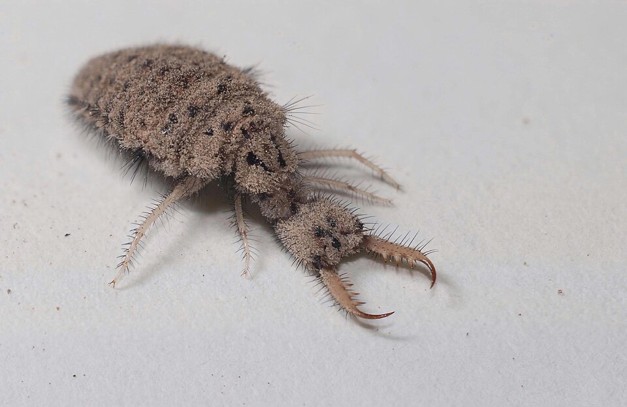
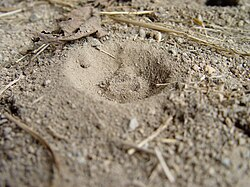
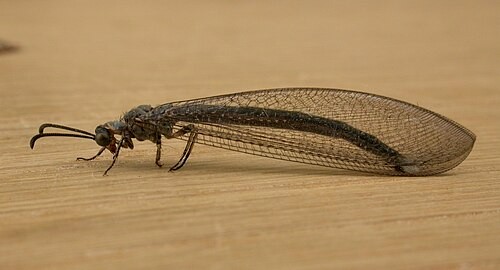
Whether this ever helped Cameroon win a football match is, of course, another question.
What struck me most during these interviews was the secrecy surrounding such practices. I always interviewed people individually, never in groups. Several informants told me that what they were revealing was a secret and that they were not really supposed to tell me.
Yet the underlying idea is perhaps not as strange as it may first appear.
Superstitions about good and bad luck exist all over the world. In Europe, almost everyone knows that Friday the 13th is supposed to be unlucky, that you should not walk under a ladder, or that a black cat crossing your path may be a bad omen. Athletes themselves are famous for their rituals: a particular pair of socks, a lucky shirt, a certain routine before an important match.
We may smile at such beliefs, but they reveal something deeply human. When the outcome of an important event is uncertain, we like to feel that there is something—anything—we can do to influence it.
But after experiencing the celebrations in Yaoundé, I understood one thing very clearly: when football matters that much, people are willing to call on every possible source of help—even insects.
Introduction
In 1995, while visiting my sister in Zambia, I was given the use of a car. That gave me the freedom to explore—and, as so often during my travels in Africa, to ask people a question that had become something of a habit:
“Do you know of any interesting uses of insects or other small creatures?”
One of my trips took me to Choma, a town about 300 kilometres southwest of Lusaka and some 200 kilometres from Livingstone and the Victoria Falls. There I visited the Choma Museum, which focuses on the history and culture of Zambia’s Southern Province.
I put my usual question to the curator.
She thought for a moment.
“Yes,” she said. “There is something. But I don’t know much about it. You should talk to a priest who lives about 50 kilometres from here.”
That was enough to make me curious. So I got back into the car and set off to find him.
Fortunately, he was at home. He welcomed me in, offered me tea, and then told me something I had certainly not expected..
It was about spiders and music
A spider web inside a xylophone.
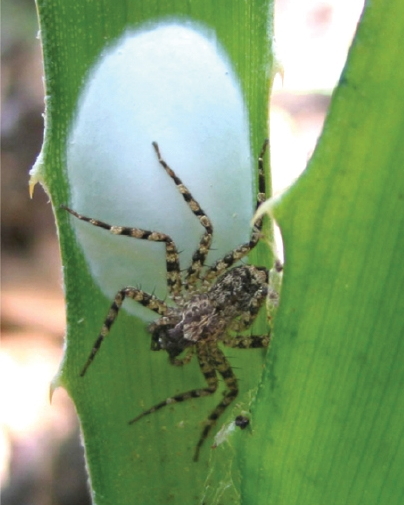
The priest explained that the dense webs made by small spiders on the walls of houses could be collected and used in traditional xylophones.
At first, this seemed rather extraordinary. What could a spider possibly have to do with a musical instrument?
The answer lies underneath the wooden keys.
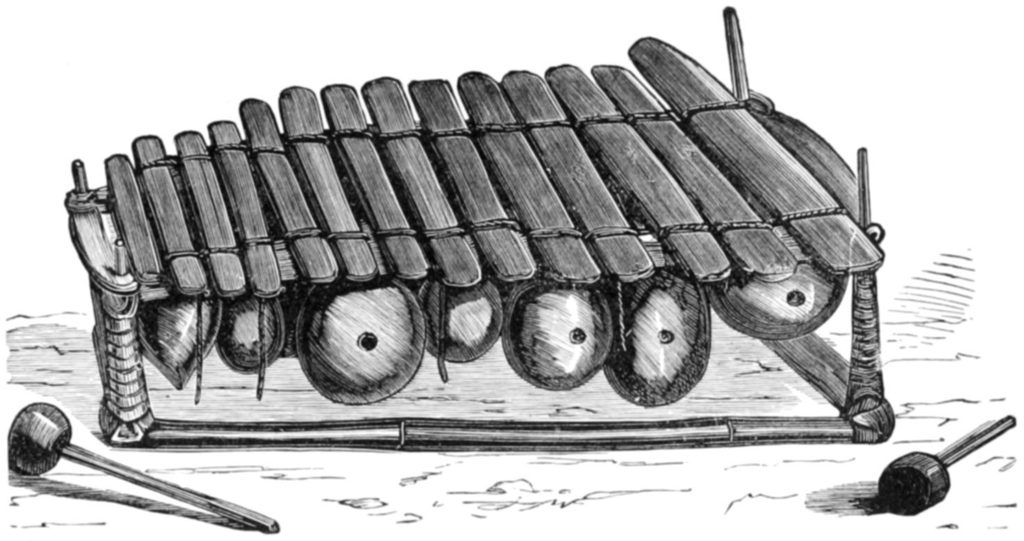
Many traditional African xylophones have dried calabashes suspended beneath them. A calabash is the hardened shell of a bottle gourd. When the fruit is allowed to mature and dry, its shell becomes hard, light and durable. For centuries, these gourds have been turned into bowls, containers—and musical instruments.
In a xylophone, the hollow calabashes act as resonators, amplifying and enriching the sound of the wooden keys above them. But there is another ingenious addition. A small opening is made in the calabash and covered with a thin membrane. When the instrument is played, the membrane vibrates, giving the note a characteristic buzzing or humming quality (see and hear now).
And the membrane can be made from spider web.
A spider web, a papaya plant—a flute
But xylophones were not the end of the story.
People also told me that children could use spider webs to make their own musical instruments.
The ingredients could hardly be simpler: a hollow plant stem and a piece of spider web.
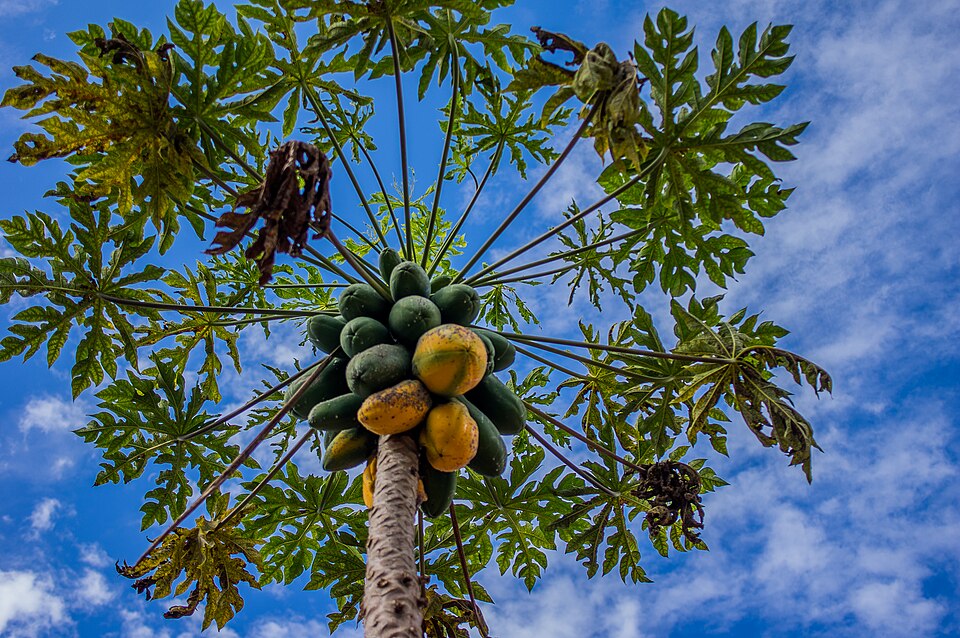
The stalk of a papaya leaf is particularly useful because it is naturally hollow, although a piece of reed can serve the same purpose. One end of the tube is covered with spider web, and the child blows through the other. The web vibrates and changes the sound. Holes can even be made along the tube so that different notes can be produced, turning this simple object into a kind of homemade flute. But from Zambia there the horn of a sable antelope is also used as a flute by making a hole in it and covering it with a membrane (read here).
A calabash can be used in much the same way.
It is a wonderful example of how musical instruments can emerge from materials found almost literally on one’s doorstep: a plant growing beside the house, a dried gourd—and a spider quietly spinning its web on the wall.
The remarkable calabash
The calabash itself deserves a special mention because it is one of nature’s great musical building materials.
Across Africa, dried gourds have been incorporated into an astonishing variety of instruments. They serve as resonators beneath the wooden keys of balafons, form the body of stringed instruments such as the n’goni and bolon, and become percussion instruments such as the shekere, where the gourd is surrounded by a net of beads or shells.
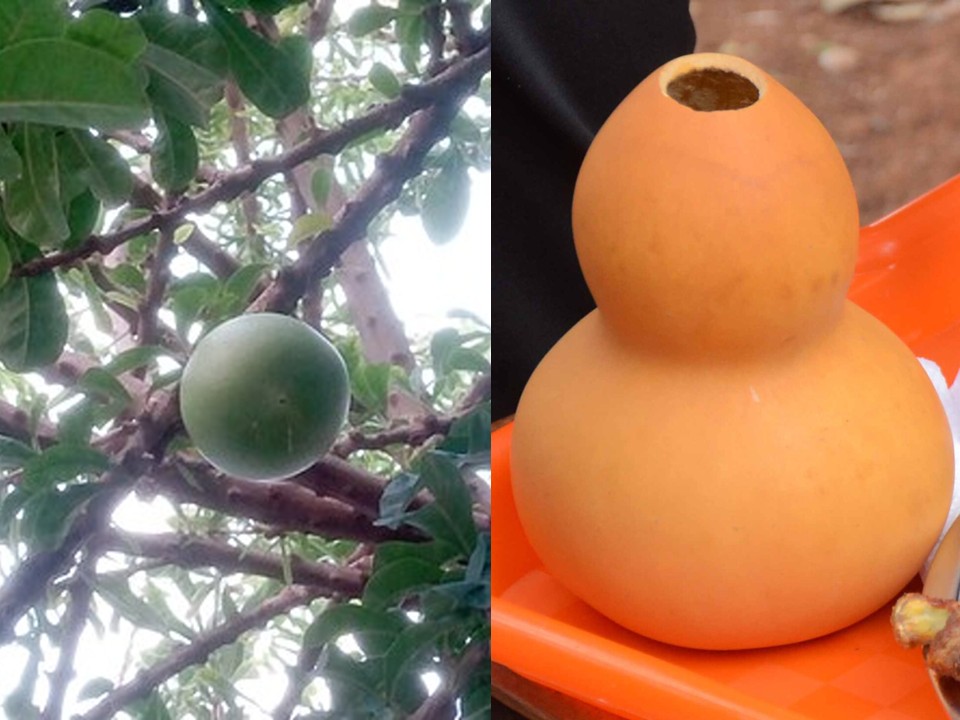
People discovered long ago what modern acoustics can explain scientifically: a hollow chamber can amplify and modify sound.
But then came another discovery. Add a delicate vibrating membrane over an opening in that chamber, and the sound changes again.
For that membrane, people made use of something that was already available in their homes.
A spider’s web.
An amulet for a Faithful Marriage
One day, my assistant took me to the famous traditional medicine and fetish market at Akodessewa, a neighbourhood of Lomé. It was an extraordinary place. Stalls were filled with an astonishing assortment of dried animals, bones, skins, skulls, herbs, and other ingredients used in traditional medicine and spiritual practices.
My assistant introduced me to a traditional practitioner, who invited me into his hut. Surrounded by the many mysterious products he had for sale, I asked the obvious question for an entomologist:
“Do you also use insects?”
The answer was most definitely yes.
He described numerous preparations in which insects were used to prevent or treat illnesses. But insects, he explained, could also play a role in magic.
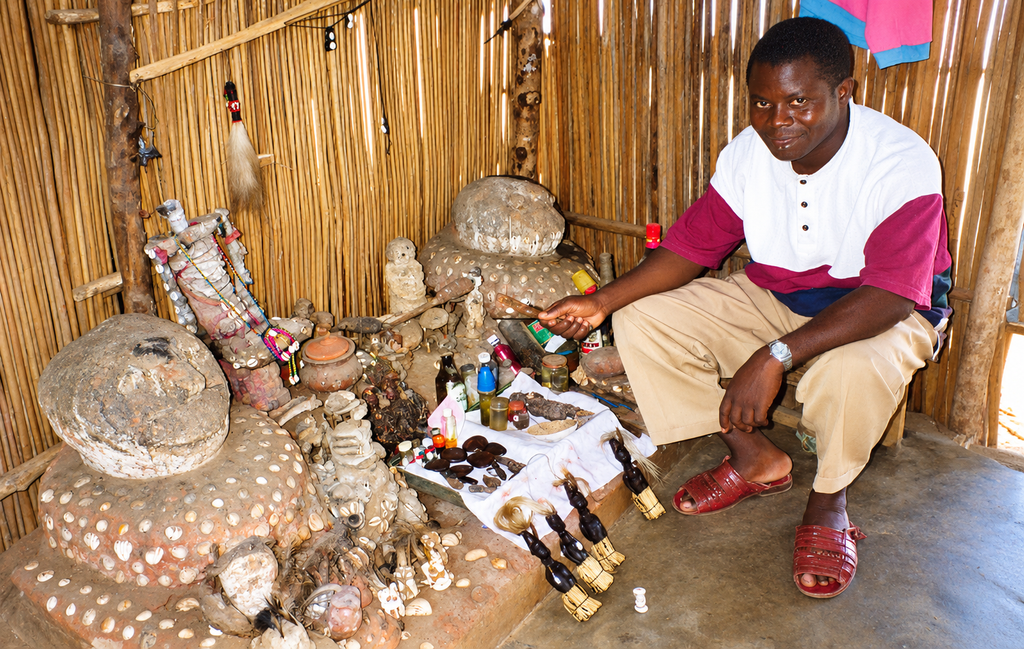
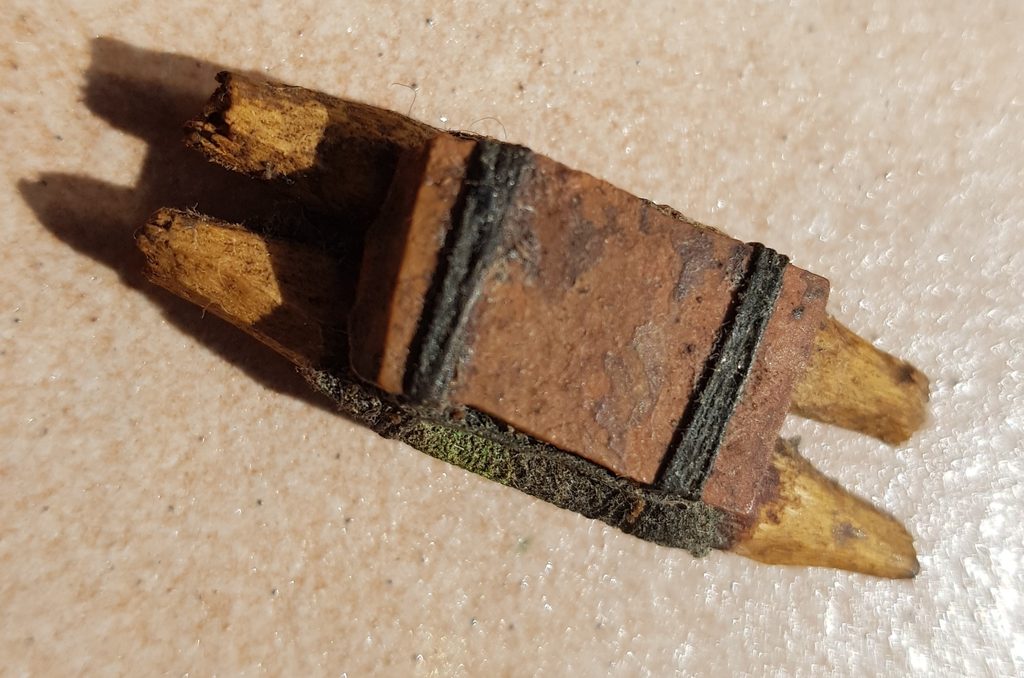
One preparation particularly caught my attention. It involved a bee and a wasp. They were ground into powder, mixed with perfume, and placed in a small box to create an amulet. According to the practitioner, it could help a woman attract a man—or a man attract a woman. Even more impressively, it could supposedly help prevent a marriage from ending in divorce.
There were precise instructions.
You had to hold the little box in your left hand and say your own name and that of your partner three times. Then you told the fetish what you wanted, folded your hands, and tapped your chest three times. Finally, you placed the box somewhere in your house.
The amulet was called Woanyinou.
Naturally, as a scientist interested in documenting such practices, I decided that this was an important research specimen.
So I bought one.
I still have it.
Interviewing an Entire Village
My assistant was convinced that the best stories were not to be found in Lomé at all.
“You must come to my village,” he insisted.
His village was Kouvé, about 75 kilometres northeast of Lomé. There, he assured me, people would have many stories about insects.
There was, however, one important requirement. If we were going to visit the village chief, we should bring him a present.
A bottle of gin.
That seemed reasonable enough, so we bought the gin and travelled by bus to Kouvé.
I had imagined that we would arrive, meet a few people, ask some questions, and collect useful information.
It did not quite work that way.
First, we were informed that our presence had to be reported to the police.
That took about an hour.
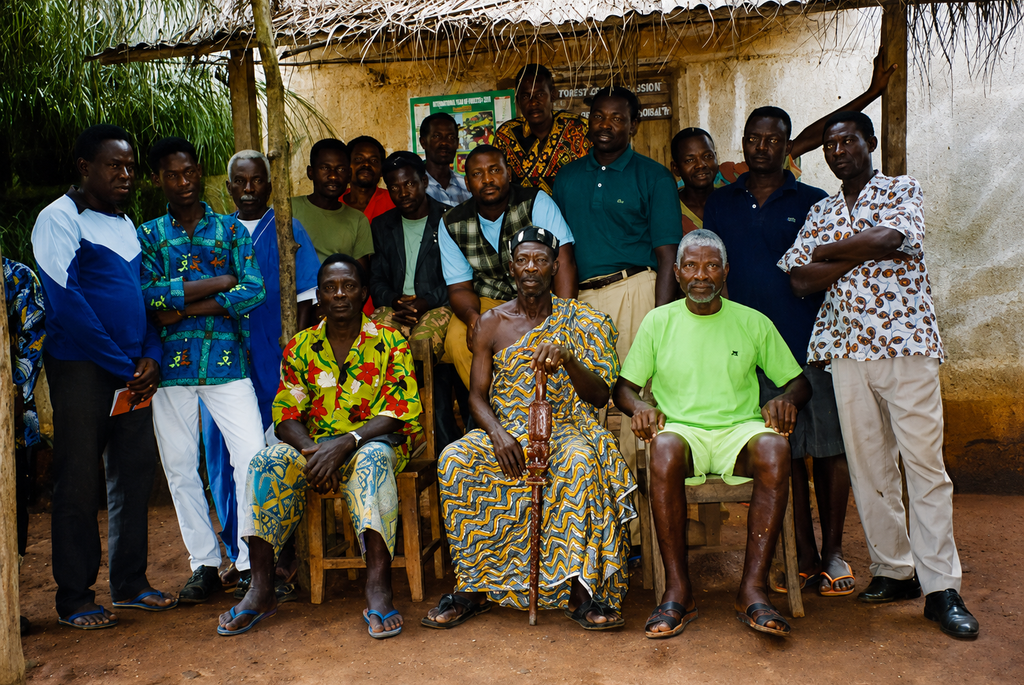
Then the village chief had to summon the elders and other knowledgeable people.
That took another two hours.
Eventually, about thirty people had gathered.
My interview could finally begin.
And then I discovered another problem: language.
I asked my questions in French. My assistant translated them into Watchi, a Gbe language closely related to Ewe. The villagers discussed the question among themselves. Their answer was then translated back into French for me.
One question could therefore produce a surprisingly long and animated discussion.
And insects created an additional complication.
I had brought a book containing pictures so that people could identify the species I was asking about. That seemed like a sensible scientific approach—until I discovered that the size of an insect in a book could cause considerable confusion.
A tiny insect might appear enormous on the page. A large insect might be reproduced at half its natural size.
“What insect is this?”
A discussion would follow.
I began to realize that identifying insects with thirty people, through two languages and with misleadingly sized illustrations, was not the quickest method of collecting scientific information.
Nevertheless, we continued.
By the end of the session, I had gathered quite a number of fascinating stories.
Then I learned about one final local custom.
It would be appropriate, I was told, to buy a beer for everyone who had participated.
I looked around at my thirty interviewees.
So, after the bus journey, the bottle of gin for the chief, the hours of waiting, and thirty beers, I had learned another useful lesson about field research:
information can sometimes be surprisingly expensive.
After that experience, whenever possible I interviewed people who worked with insects and knew them well. If I mentioned a particular species, they usually knew exactly which insect I meant. With a whole village, insect identification could become an investigation in itself.
Still, the visit to Kouvé produced many wonderful stories. Two, involving spiders, have stayed with me.
Sudan: Where Bee Stings Became Medicine
During my travels through sub-Saharan Africa, I was collecting stories about the many ways insects feature in people’s lives—not only as food or agricultural pests, but also in medicine, beliefs and traditions. One of those journeys took me to Sudan, where I encountered a particularly intriguing example: bees being used not for their honey, but for their stings.
I had a useful contact in Wad Medani, a city southeast of Khartoum. The leader of an Integrated Pest Management (IPM) project there was a Polish scientist whom I already knew from Kenya, where he had worked at the International Centre of Insect Physiology and Ecology (icipe). He had also visited me once in the Netherlands.
His hospitality made my work in Sudan remarkably easy. He arranged for a driver to collect me from the airport in Khartoum, organized my interviews and provided transport throughout my stay. All I had to do was ask questions—and listen.
More than honey
Bees came up frequently in my interviews. At first, this did not surprise me. Honey is found in households throughout much of sub-Saharan Africa and has a long tradition of medicinal use. People told me about using it for all kinds of illnesses and ailments, as well as for treating burns—an important household remedy in places where cooking is often done over open fires.
But in Sudan, the conversations about bees took an unexpected turn.
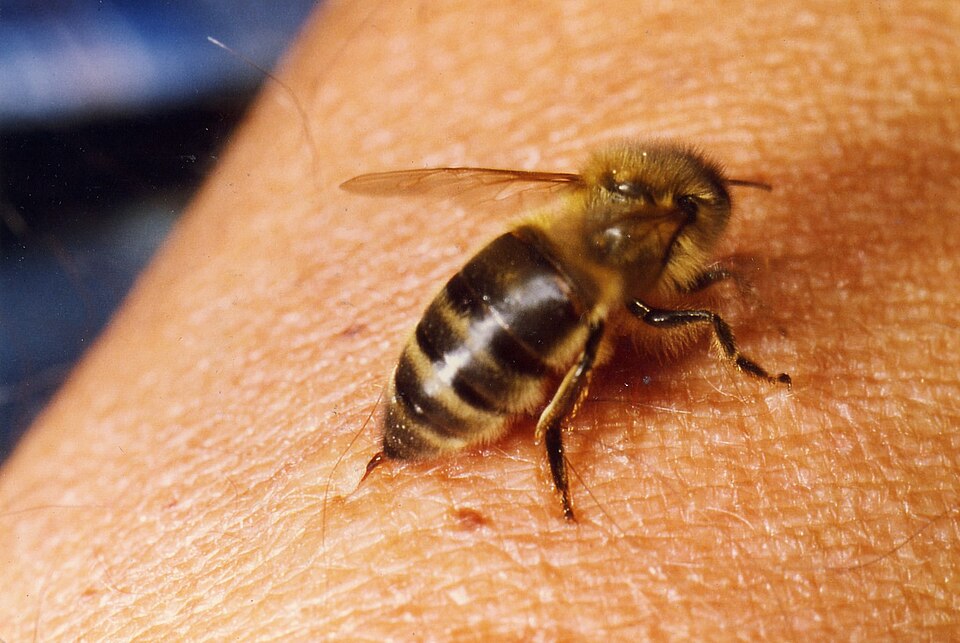
People repeatedly told me about using bee stings to treat rheumatism and painful joints.
I had heard similar stories elsewhere in Africa, but in Sudan the practice seemed unusually widespread. It almost appeared to be a national folk remedy for rheumatic complaints.
A bee expert explained the treatment to me quite matter-of-factly. If someone suffered from back pain, several bees could be made to sting the painful area—he suggested five stings. For pain in the legs, the stings might be applied around the middle of the thighs.
To me, this was fascinating. Most people instinctively try to avoid being stung by a bee. Here, the sting itself was considered the medicine.
And the idea was by no means unique to Sudan. Bee venom has a surprisingly long history in attempts to treat rheumatism and arthritis. More than a century ago, European physicians were already experimenting with what eventually became known as bee venom therapy, or apitherapy.
A final day that did not go according to plan
My stay in Wad Medani was supposed to end quite differently.
I had promised the IPM project leader that, on my final day, I would give a talk to a group of vegetable farmers participating in his project. Early that morning, we climbed into a minibus and set off for the project site, about 80 kilometres away.
We did not get far.
Just outside Wad Medani, a man riding a donkey crossed the road. Our driver failed to see him in time.
There was a serious accident.
The man was badly injured and had to be taken to hospital. Everything came to a halt, and our journey was delayed by about four hours.
Eventually, the others continued towards the IPM project. For me, however, there was now another problem. I had a plane to catch from Khartoum. If I continued with them, I risked missing it.
So instead of spending my final hours in Sudan talking with vegetable farmers about pest management, I found myself heading back towards Khartoum and the airport.
It was an abrupt ending to the visit.
Yet what stayed with me was something I had not expected to discover at all. I had travelled to Sudan looking for cultural stories about insects. I left with the remarkable image of an insect most of us try not to provoke: a bee deliberately placed on a painful joint, its sting transformed from something to fear into something believed to heal.