
Table of Contents
ToggleThe Plane Crash That Changed My Life—and My University
In the late 1987, I embarked on what was supposed to be a routine mission to Sudan and Kenya. Little did I know that the trip would end in a plane crash, a year-long recovery, and a chain of events that would permanently influence my career—and even the future direction of Wageningen University’s Entomology Department.
A Mission to Africa
The head of our Department of Entomology and I were traveling on behalf of the Directorate-General for International Cooperation (DGIS) of the Dutch Ministry of Foreign Affairs.
Our first stop was Sudan, where we evaluated the progress of a Dutch-funded project on integrated pest management in the Gezira cotton-growing region (see the story here). From there, we flew to Nairobi, Kenya. We stayed at the Hilton Hotel and visited the headquarters of the International Centre of Insect Physiology and Ecology (icipe), a renowned research institute that hoped to receive Dutch funding for new projects.
The welcome was warm and enthusiastic. During discussions, one request stood out: icipe asked whether Dutch funding could be used to purchase a bus to transport staff between Nairobi and the institute’s headquarters.
My colleague was clearly irritated. He considered it an inappropriate use of project funds and was about to say so rather bluntly. Having encountered such requests before, I intervened. Diplomatically, I replied that it was “a very interesting proposal that would be carefully studied and considered”—which, in development cooperation language, essentially meant “no.”
Everyone left the meeting satisfied.
A Flight to Lake Victoria
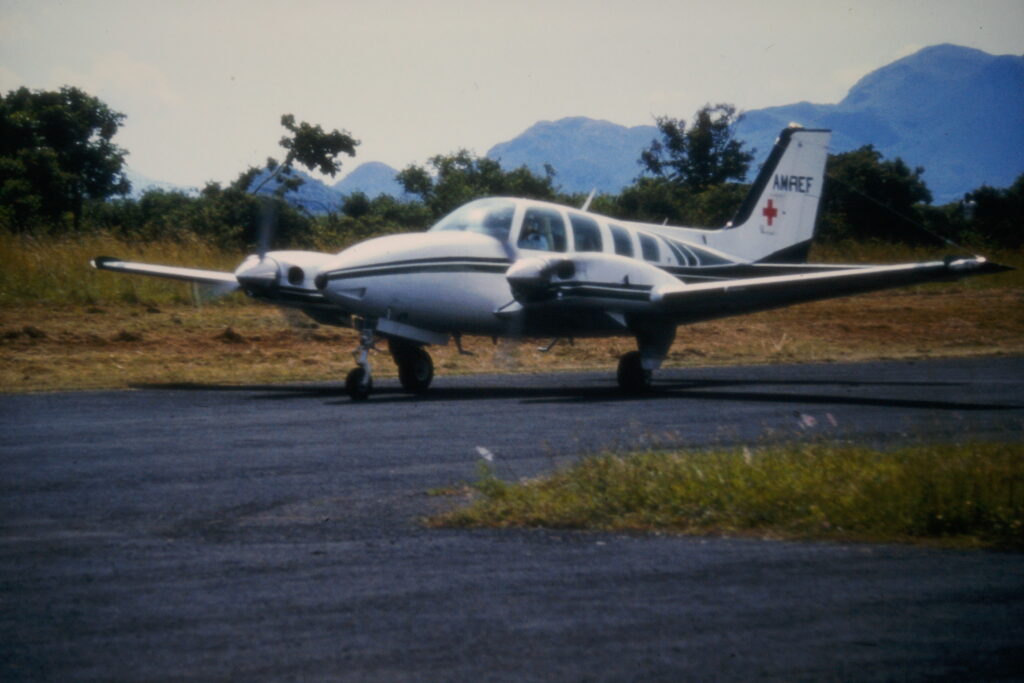
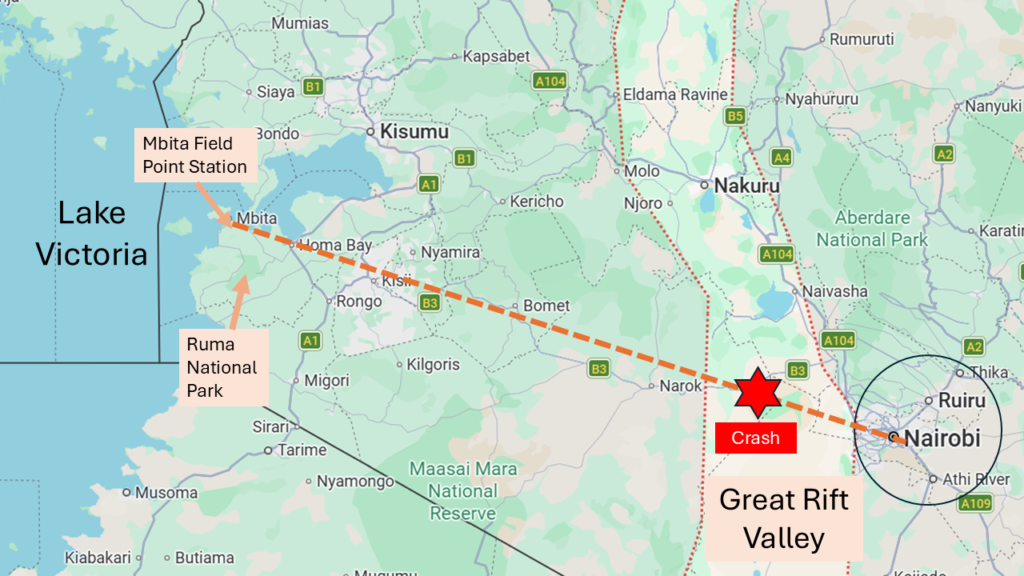
One of the highlights of our visit was a trip to Mbita Field Station, an icipe research facility on the shores of Lake Victoria. The Netherlands had helped finance its establishment, and icipe was eager to show us the results.
To make a one-day visit possible, a small six-seater aircraft was chartered from AMREF, the famous Flying Doctors service.
The passengers included the Deputy Director of icipe, the head of the tsetse fly programme, another scientist, my colleague, the pilot, and me.
Before departure, I noticed something unusual. The pilot checked the fuel level by inserting a branch into the fuel tank. At the time, I thought little of it. Only later did I realize that the plane’s fuel gauge apparently wasn’t working.
After a productive visit to Mbita, we boarded the aircraft for the return journey to Nairobi.
Trouble in the Air
The flight began pleasantly. We chatted, admired the landscape below, and watched wildlife roaming through what is now Ruma National Park.
Then we crossed the Great Rift Valley, one of Africa’s most spectacular geological features.
Without warning, the aircraft began to descend.
Oddly enough, nobody seemed alarmed. The conversations continued. Only my colleague appeared slightly concerned; I remember him checking his seatbelt.
The ground, however, was approaching rapidly.
Suddenly it became clear: this was not a normal descent.
We were making an emergency landing.
The pilot selected a grassy field near a primary school. Unfortunately, the school grounds were surrounded by concrete fence posts.
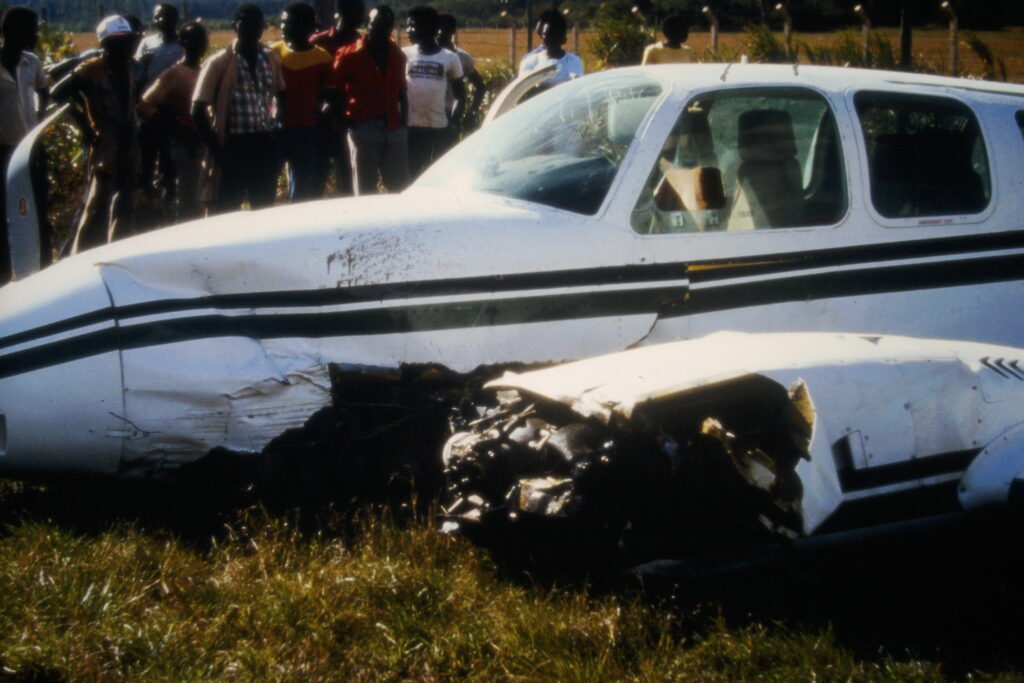
In an extraordinary display of skill, he managed to guide the fuselage between two posts. But the gap was too narrow for the wings.
Both wings were torn off.
The impact was violent.
Escape From the Wreckage
The aircraft came to a halt. Everyone immediately scrambled out, expecting the plane to burst into flames.
It never did.
The cause of the emergency was remarkably simple: we had run out of fuel.
Everyone escaped—except me.
The crash had ripped my seat loose. My left leg had slammed into a metal structure beneath the elevated pilot’s seat. The injury was devastating. My leg was shattered, and I could not move.
When the others realized I was trapped, they rushed back and pulled me from the wreckage.
Only then did I fully understand how serious my injuries were.
The Race to Save Us
The pilot activated the aircraft’s emergency beacon, transmitting an SOS signal.
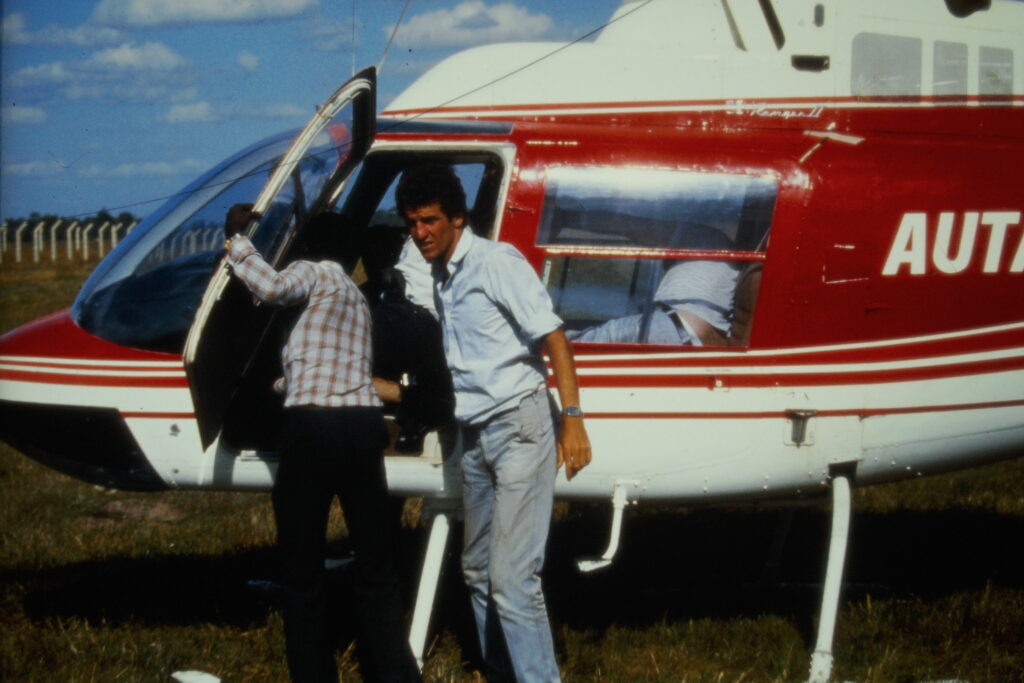
Before long, a rescue helicopter arrived.
It was the first—and so far only—time I have ever flown in a helicopter.
We were transported to a hospital in Nairobi. As often happens in hierarchical organizations, the senior officials were treated first. I was attended to last, despite having by far the most serious injuries.
The others had escaped with little more than bruises.
My memories of the following days are vague. Heavy sedatives blurred much of what happened.
Doctors decided not to perform major surgery in Kenya. Instead, arrangements were made to fly me back to the Netherlands, where treatment could take place under safer conditions.
One memory does stand out. Professor Thomas Odhiambo, the founder and director of icipe, visited me in the hospital. During his visit he confessed that he hated hospitals (see the story here).
At that moment, lying in a hospital bed with a shattered leg, I could not disagree.
A Long Journey Home
Several days later I was flown back to the Netherlands in first class.
Before departure, medical staff tested whether I could walk with crutches. It quickly became obvious that I could not.
Only later did I learn how close I had come to death. One of the broken bones in my leg was touching a major artery. A single wrong movement could have caused a fatal internal hemorrhage.
My colleague later told me he suffered recurring nightmares about the accident.
I never did. Physical reality was enough.
An ambulance transported me from Nairobi Airport, and another met me upon arrival in Amsterdam before taking me to a hospital near Wageningen.
Rebuilding a Leg
The surgery lasted four hours.
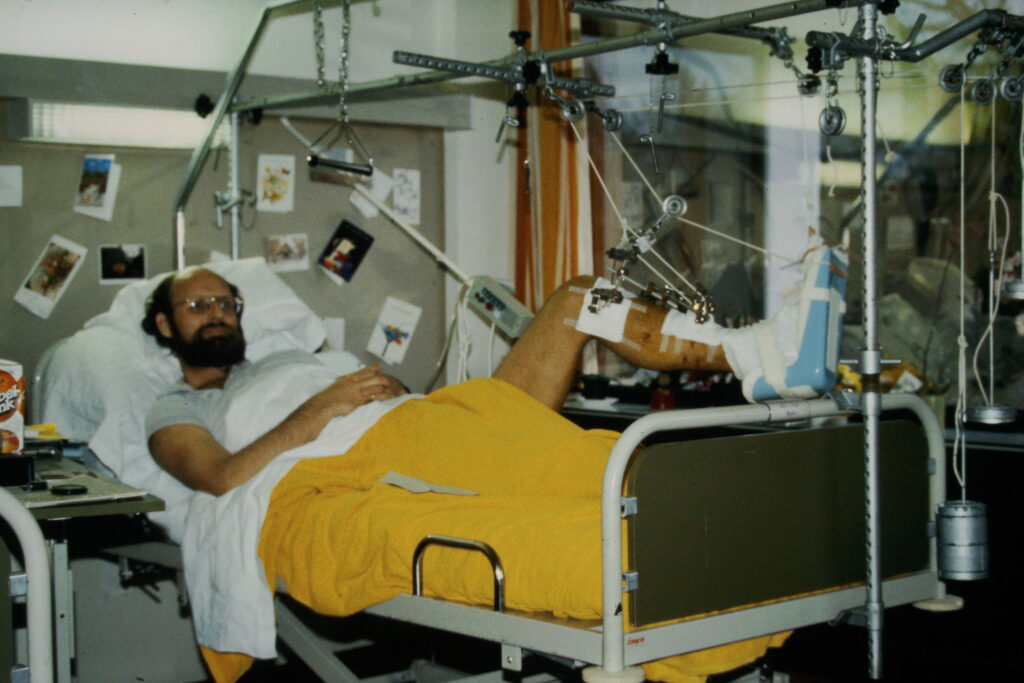
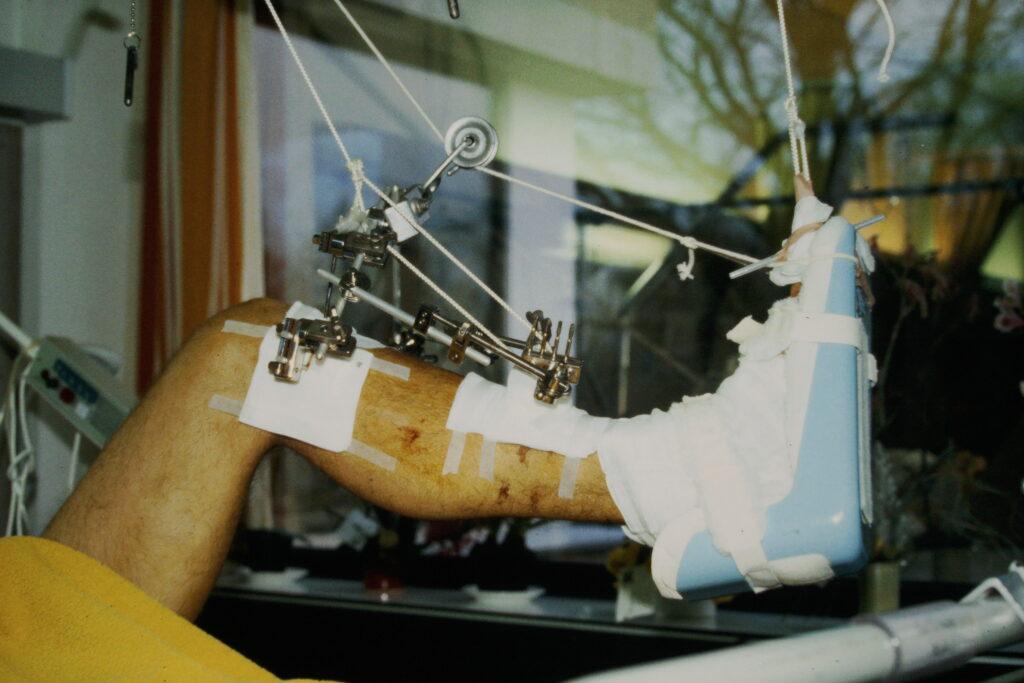
Orthopedic surgeons reconstructed my leg using screws, metal rods, and an external fixation frame. Metal bars protruded through the skin and were connected by a framework outside my leg.
The damage extended beyond the leg itself.
My big toe had been driven completely into my foot during the impact. To restore it, surgeons inserted a screw into the toe and gradually pulled it back into position using weights and a pulley system.
My heel had lost nearly all its skin.
Recovery was slow and painful.
For two months I lay flat on my back in hospital. Doctors discovered that a vertebra in my spine had also been fractured.
The pain was sometimes unbearable. Fellow patients occasionally pleaded with nurses to give me additional medication because my groans kept the entire ward awake.
Morphine became my temporary companion.
Another Brush With Death
After two months, I was finally allowed to go home.
My leg remained immobilized in its external frame. A colleague built a wooden support structure so I could rest it comfortably.
I was allowed only short walks on crutches.
Then another crisis struck.
A physician noticed alarming symptoms and immediately sent me back to hospital, where I spent three days in intensive care.
The cause was shocking.
When I had been discharged earlier, the hospital had forgotten to prescribe blood thinners—a standard precaution for bedridden patients.
A dangerous blood clot had formed.
For the second time in a matter of months, I narrowly escaped death.
Learning to Walk Again
Recovery was measured not in weeks but in years.
It took a full year before I could return to work.
Even then, I could not stand long enough to lecture. I delivered my classes seated because of the spinal injury.
Gradually, strength returned.
After two years, the injuries had healed sufficiently for me to resume a normal life.
Yet one consequence lingered.
For at least five years, I was deeply uneasy whenever I boarded a small aircraft.
Unfortunately, my work frequently took me to places where small planes were the only option. Flights between Zanzibar and Pemba Island, for example, left me with little choice but to confront those fears repeatedly.
The Unexpected Legacy of a Plane Crash
The accident had one final consequence that nobody could have predicted.
At the time, my university teaching covered two subjects:
- Integrated pest management of tropical crops.
- The control of insect vectors that transmit tropical diseases.
Because I was unable to teach for an extended period, a temporary replacement was recruited.
Unlike me, he was a true specialist in vector-borne diseases such as malaria, sleeping sickness, and other illnesses transmitted by blood-feeding insects.
After a year, the university decided to keep him permanently.
That decision eventually led to the development of a major research group specializing in disease vectors and blood-feeding arthropods—an area that remains an important part of Wageningen University’s Entomology Department today.
It is strange to think that a plane crash in rural Kenya, caused by something as mundane as an empty fuel tank, helped shape the future of scientific research thousands of kilometres away.
Some accidents leave scars.
Others leave legacies.
This one did both.