Table of Contents
ToggleIPM in Zanzibar using Farmer Field Schools
From Wageningen University & Research, I became involved in the project “Strengthening the Plant Protection Division of Zanzibar” in 1986, initially as an evaluator. Over the years, my role expanded to include backstopping, project formulation, and coordination between 1993 and 1999.
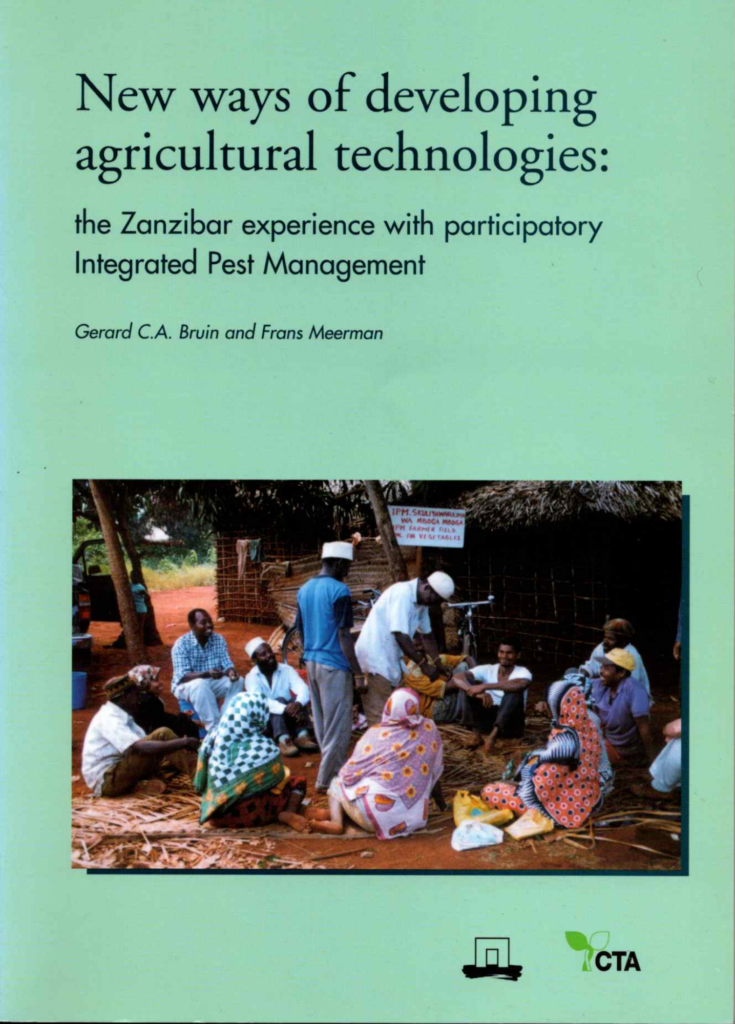
During this period, Gerard Bruin served as project manager of the Integrated Pest Management (IPM) programme (1994–1997). His experiences have been captured in this book. He was supported by Frans Meerman, an experienced IPM specialist. The book’s preface was written by Peter Kenmore.
Peter Kenmore is widely recognized as a pioneering agricultural scientist who helped develop and promote the Farmer Field School (FFS) approach. Through his work with the Food and Agriculture Organization (FAO) in the 1980s and 1990s, he played a leading role in advancing farmer-led learning through IPM programmes, particularly in rice farming systems across Southeast Asia.
What is described in the book
This compelling book tells the story of a remarkable sixteen-year journey of international collaboration in crop protection in Zanzibar. What began as a traditional, top-down effort to strengthen a government plant protection organization evolved into an inspiring, people-driven movement that empowered smallholder farmers and transformed subsistence agriculture.
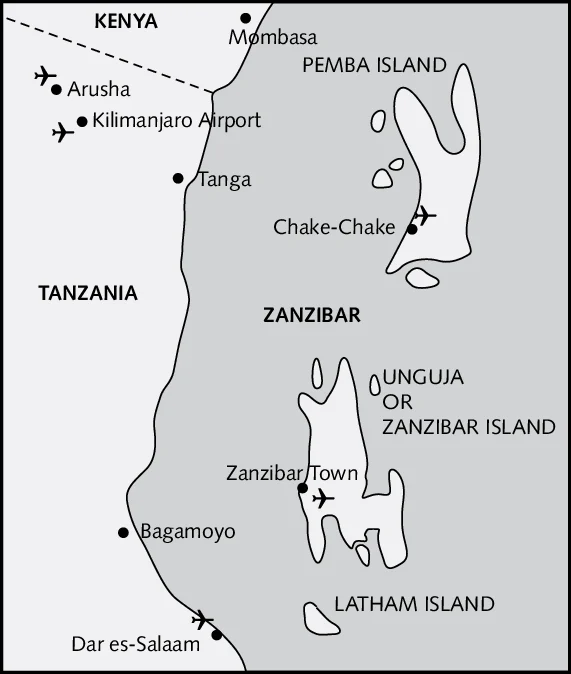
Through vivid, real-world experiences from Farmer Field Schools (FFS) on the islands of Unguja and Pemba, the book brings to life the challenges, breakthroughs, and impact of this innovative approach. It showcases results across five diverse cropping systems and reveals powerful lessons learned from both successes and setbacks. At its core, the book highlights how the FFS model—originally developed for rice farming in Southeast Asia—was successfully adapted to the unique ecological and socio-economic realities of East African farming communities.
More than just a case study, this book offers a rich, multidisciplinary perspective on agricultural development, addressing not only biological and ecological factors, but also the social, economic, political, and institutional forces that shape real change.
The message is clear and hopeful: Farmer Field Schools can thrive in East Africa—when the right conditions are in place. By building awareness, fostering trust, creating strong partnerships, enabling supportive policies, and mobilizing resources, FFS becomes a powerful catalyst for collaboration and innovation. While meaningful transformation requires time and commitment, this book demonstrates that lasting impact is not only possible—it is already happening.
What is a farmer field school?
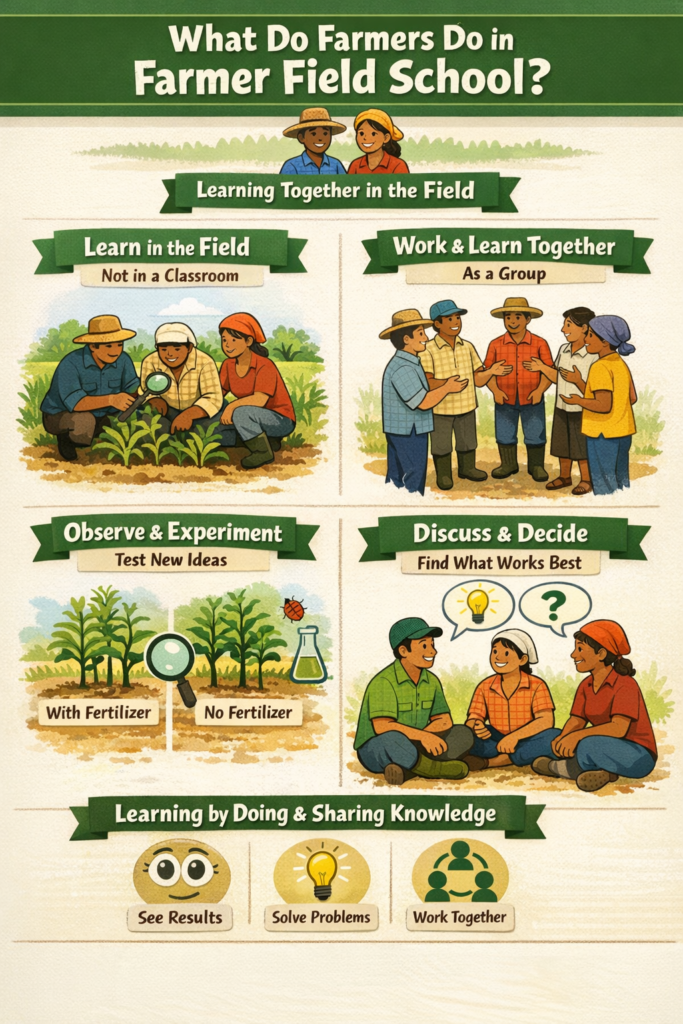
A Farmer Field School (FFS) is a simple idea: farmers learn by doing, together, in their own fields.
Instead of sitting in a classroom or just being told what to do, a group of farmers meets regularly during a growing season. They observe their crops, experiment with different methods, and discuss what they see. Often, they compare things like using fertilizer vs. not, or different pest control methods.
A trained facilitator guides the group—but doesn’t lecture. The farmers themselves make observations, ask questions, and learn from each other.
In simple terms:
- 🌱 Learn in the field, not in a classroom
- 👩🌾 Farmers work and learn together
- 🔍 They observe, experiment, and discuss
- 💡 They discover what works best for their own situation
Why it works:
Because farmers see results with their own eyes, they trust what they learn. It also builds confidence, problem-solving skills, and cooperation within the community.
How does a farmer field school function?