Desert Locust

dl
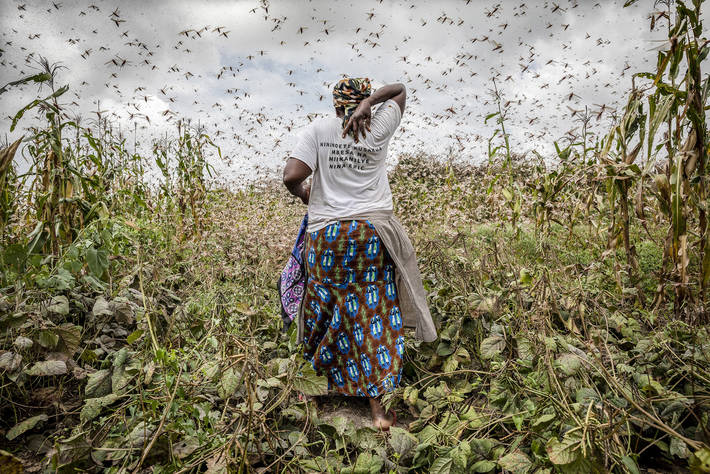
Fig. D1. Desert Locust swarm
untitled design
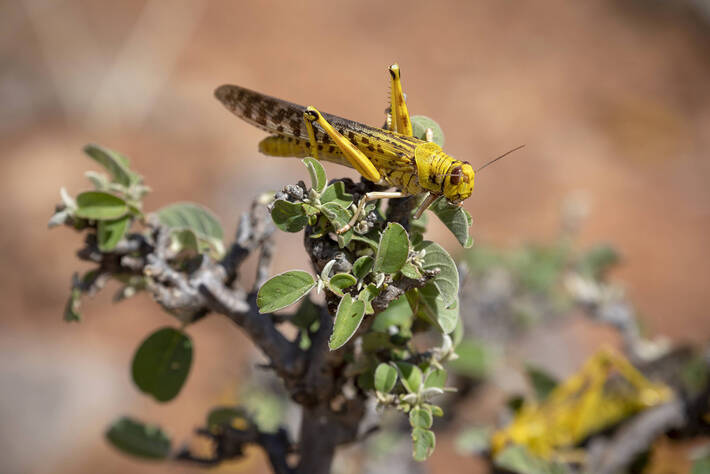
Fig. D2 The adult desert locust

Overview

general

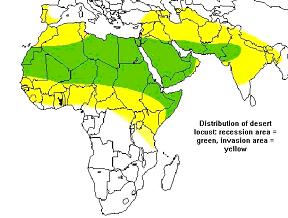
The desert locust (Schistocerca gregaria) is a dangerous insect that can damage crops across a huge area — from Mauritania in West Africa to India, and from the Mediterranean down to the Equator. This area covers about 16 million square kilometers of dry land.

Current Strategy

The main strategy today is to stop outbreaks early before they turn into full plagues. This means controlling locusts during the outbreak or early upsurge stage. However, there is little field evidence proving this strategy always works. Some studies suggest it may not be very effective. Because plagues happen irregularly, management often becomes crisis-based instead of well-planned.

Locusts Come In Cycles

  • Recession (Quiet Period). Most locusts are scattered in dry desert areas. Populations are low. Damage is limited.
  • Heavy and widespread rain creates good breeding conditions. Locust numbers start increasing quickly.
  • New generations move to new areas and continue breeding. Populations grow even larger.
  • Huge swarms of flying adults form. Large groups of young locusts (called hopper bands) move together. Serious crop damage occurs across several countries.

Desert locust numbers go up and down over time.

What about costs

We don’t know the exact total cost of locust damage. It is also unclear whether the money spent controlling locusts equals The value of crops saved

However, for individual farmers, losses can be devastating. Entire fields can be destroyed. Protecting crops locally is very difficult, and financial compensation is hard to provide.

Why is it a political problem

Desert Locusts Are Also A Political Issue Because: Swarms Are Dramatic And Attract Attention. They Move Across National Borders. Many Countries Can Be Affected At The Same Time. During Plagues, Donor Countries Often Send Insecticides, Aircraft For Spraying. But Sometimes Aid Is Sent Without Fully Checking What Is Really Needed. Also Countries May Not Have The Capacity To Use Everything. Leftover Insecticides Create Storage And Disposal Problems.

Current strategy

The Main Strategy Today Is To Stop Outbreaks Early Before They Turn Into Full Plagues. This Means Controlling Locusts During The Outbreak Or Early Upsurge Stage. However, There Is Little Field Evidence Proving This Strategy Always Works. Some Studies Suggest It May Not Be Very Effective. Because Plagues Happen Irregularly, Management Often Becomes Crisis-Based Instead Of Well-Planned.

Recent improvemets

Researchers Are Working On Better Tools And Methods, Including The Use Of GIS (Geographic Information Systems) To Analyze Survey Data, Using GPS And Precision Spraying For Better Targeting, Studying How Locusts Change Behavior From Solitary To Swarming, Use Of Longer-Lasting Insecticides In Barrier Treatments, And The Development Of Biopesticides (Such As Fungi That Infect Locusts), And Finalize Monitoring Environmental Conditions More Closely

What still needs to improve

Experts say we need to 1) Learn more about locusts during quiet (recession) periods; 2) Carefully evaluate control campaigns, 3. Develop better outbreak prevention strategies, 4. Prepare strong emergency plans for plagues;5) Train people to carry out these plans effectively

In Simple Terms: Desert locusts are unpredictable and can cause massive crop losses across countries. New technology helps, but better planning, organization, and preparation are just as important as new scientific discoveries.

rtemagicc 6c920b5d16.jpg

Fig D3. Distribution area of the desert Locust.

Green: recession area

Yellow: invasion area

PhD thesis supervised

  • Woldewahid, G., 2003. Habitats and spatial pattern of solitarious desert locusts (Schistocerca gregaria Forsk.) on the coastal plain of Sudan. Supervision with Prof. J.C. van Lenteren, and Dr. W. van der Werf. Promotion date: 16 Dec 2003. https://doi.org/10.18174/121499

Publications

Refereed

  • Van Huis, A, G. Woldewahid, K. Toleubayev, and W. van der Werf, 2008. Relationships between food quality and fitness in the desert locust, Schistocerca gregaria, and its distribution over habitats on the Red Sea coastal plain of Sudan. Entomologia Experimentalis et Applicata, 127(2): 144 – 156. http://dx.doi.org/10.1111/j.1570-7458.2008.00682.x
  • Van Huis, A, 2007. Strategies to control the Desert Locust Schistocerca gregaria. In Vreysen, M.J.B., A.S. Robinson, and J. Hendrichs (Eds.), Area-Wide Control of Insect Pests: From Research to Field Implementation, pp 285-296. Springer, Dordrecht, The Netherlands.
  • Van Huis, A, K. Cressman, and J.I. Magor, 2007. Preventing desert locust plagues: optimizing management interventions. Entomologia Experimentalis et Applicata, 122: 191–214, 2007. http://dx.doi.org/10.1111/j.1570-7458.2006.00517.x
  • Van Huis, A, 2007. Locust control by early identification of breeding sites. Encyclopedia of Pest Management, 1:1, 1-3. To link to this article: http://dx.doi.org/10.1081/E-EPM-120037615
  • Woldewahid, G., W. van der Werf, K. Sykora, T. Abate, B. Mostofa, and A. van Huis, 2007. Description of plant communities on the Red Sea coastal plain of Sudan. Journal of Arid Environments, 68: 113-131. https://doi.org/10.1016/j.jaridenv.2006.04.003
  • Werf, W. van der, G. Woldewahid, A. van Huis, M. Butrous, and K. Sykora, 2005. Plant communities predict the distribution of solitarious desert locust Schistocerca gregaria. Journal of Applied Ecology, 42: 989 -997. https://doi.org/10.1111/j.1365-2664.2005.01073.x
  • Woldewahid, G., W. van der Werf, A. van Huis, and A. Stein, 2004. Spatial distribution of populations of solitarious adult desert locust (Schistocerca gregaria Forsk.) on the coastal plain of Sudan. Agricultural and Forest Entomology, 6 (3): 181-191. https://doi.org/10.1111/j.1461-9555.2004.00221.x
  • Van Huis, A, 1997. Can we prevent desert locust plagues? In: New strategies in locust control (Eds.: S. Krall, R. Preveling and D.B. Diallo), pp. 453-459. Birkhäuser Verlag, Basel. 522 pp.
  • Van Huis, A, 1995. Desert locust plagues. Endeavour, 19(3): 118-124.

Non-refereed

  • Van Huis, A, 2006. Vraatzuchtige zwermen woestijnsprinkhanen. In Muggenzifters en Mierenneukers: insecten onder de loep genomen (Eds: Ties Huigens, Peter de Jong), pp. 184-195. Laboratorium voor Entomologie. Wageningen Universiteit.
  • Van Huis, A, K. Cressman, and J.I. Magor, 2005. Preventing desert locust plagues: optimizing management interventions. Metaleptea (The newsletter of the Orthopterists’Society – special meeting issue). Ninth International Conference of the Orthopterists’ Society “Integrative Biology in Orthopteran Research”, August 14-19, 2005. Canmore Alberta, presented by the Orthopterist Society and University of Lethbridge, p. 83.
  • Van Huis, A, 2005. Strategies of Desert Locust Control. FAO/IAEA International Conference on Area-wide control of insect pests: integrating the sterile insect and related nuclear and other techniques. Book of Extended Synopsis (IAEA-CN-131/144), p. 20.
  • Van Huis, A, 2004. How to manage the locust threat? Policy paper for the Directorate General of Development Cooperation, Ministry of Foreign Affairs. 13 pp.
  • Woldewahid, G., Werf, W. van der, Sykora, K.V., Stein, A., Butrous, M., & Van Huis, A (2004). Habitats and spatial pattern of solitarious desert locusts (Sschistocerca gregaria) on the coastal plain of Sudan. In   (Ed.), XVth international Plant Protection Congress, 11-16 May 2004, Beijing.
  • Werf, W. van der, G. Woldewahid, T. Abate, M. Butrous, O. Abdallah, A.M. Khidir, B. Mustafa, I. Magzoub, O. Abdin, A. Stein, and A. van Huis, 2003. Spatial distribution of the Desert Locust, Schistocerca gregaria, on the Plains of the Red Sea Coast of Sudan during the winter of 1999. In: Conference on Agricultural and Environmental Statistical Applications in Rome, 4‑8 June 2001. Essays ISTAT, No 12/2002. Vol. 1: 167‑171.
  • Woldewahid, G., T. Abate, M. Butrous, O. Abdalla, A.M. Khidir, B. Mustafa, I. Magzoub, O. Abdin, A. Stein, W. van der Werf, and A. van Huis, 2001. The search for locust habitat (poster). FAO and Wageningen University.
  • Woldewahid, G., T. Abate, M. Butrous, O. Abdalla, A.M. Khidir, B. Mustafa, I. Magzoub, O. Abdin, A. Stein, W. van der Werf, and A. van Huis, 2001. The search for solitary Desert Locust (Schistocerca gregaria) habitat during winter breeding in the plains of the Sudan Red Sea coast. Metaleptea (special meeting issue), pp. 79-80. Eight International Meeting of the Orthopterist’s Society, August 19-22, Montpellier France.
  • Van Huis, A, 1994 (Editor). Desert locust control with existing techniques: an evaluation of strategies. Proceedings of the Seminar held in Wageningen, the Netherlands, 6-11 December 1993. 132 pp. ISBN 90-6754-364-0.
  • Van Huis, A, 1994 (Éditeur). Lutte contre le Criquet pèlerin par les techniques existantes: évaluation des stratégies. Compte-rendu du Séminaire de Wageningen, Pays-Bas, 6-11 décembre 1993. 140 pp. ISBN 90-6754-363-2.
  • Van Huis, A, 1994. Can we combat the Desert Locust successfully? In: Proceedings of the Seminar Desert Locust control with existing techniques (Ed.: A. van Huis), p. 11-17.
  • Van Huis, A, 1994. Peut-on réussir la lutte contre le Criquet pèlerin? Dans: Compte-rendu du Séminaire de Wageningen Lutte contre le Criquet pèlerin par les techniques existantes: évaluation des stratégies (Éd.: A. van Huis), p. 11-17.
  • Van Huis, A, 1992. New developments in locust management and control. Proc. Exper. & Applic. Entomol., N.E.V. Amsterdam, 3: 2-18.
  • Van Huis, A, 1987. Sprinkhanenplagen in Afrika (grasshopper and locust pests in Africa). Natuur en Techniek, 55 (3): 182-193.
  • Everts, J.W., and A. van Huis, 1987. Sprinkhaanbestrijding in de Sahel. NRC Handelsblad van 9 juli 1987 (rubriek Wetenschap en Onderwijs).
  • Van Huis, A, 1993. The Netherlands’ contribution in the development of Desert Locust control strategies. International Workshop on Research and Planning for Desert Locust Control, 24 – 28 May 1993. FAO, Marrakech, Morocco.

Training manual

  • Symmons, P., and A. van Huis, 1997. Desert Locust Control campaign studies: operations guidebook. Wageningen University. 167 pp. & CD-Rom, 19 floppy disks