Insects as food and feed
Global organization
Achievements
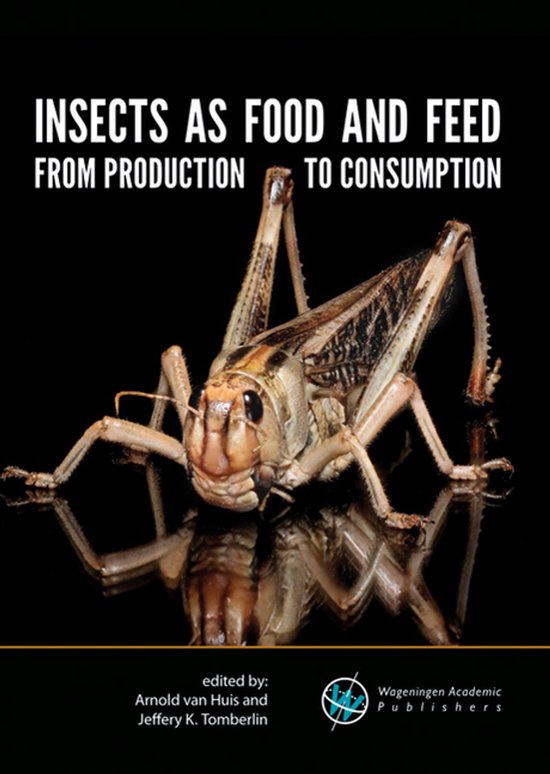
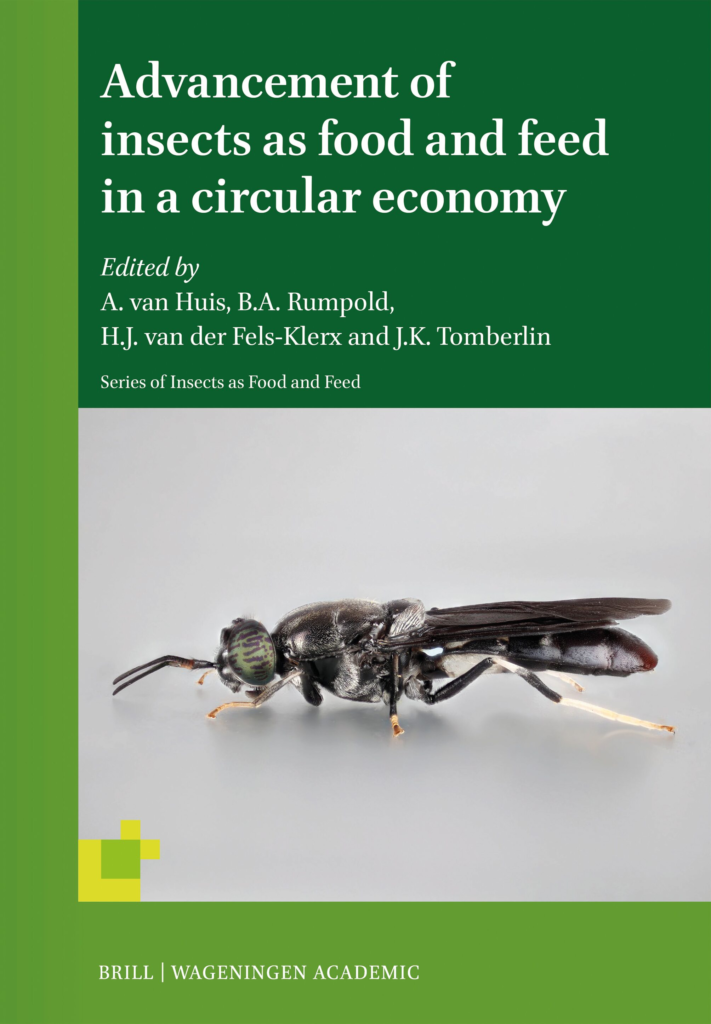
Several books published
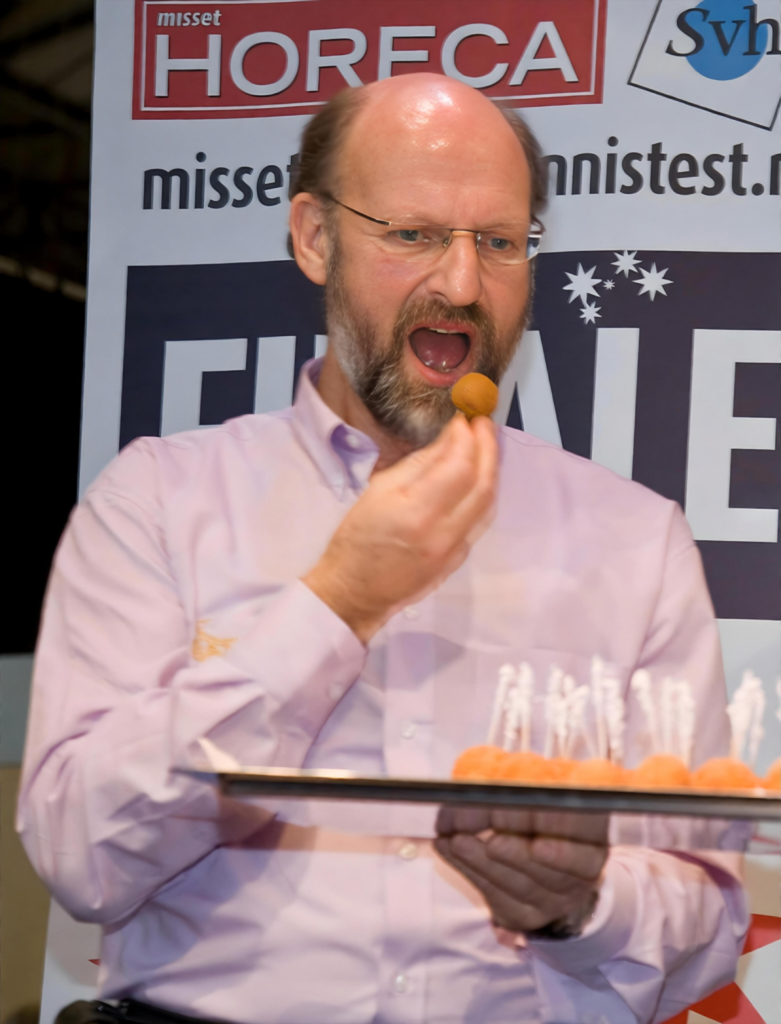
Project SUPRO2: Sustainable Production of Insect Proteins for Human Consumption
PhDs supervised
- Shumo, M.A.H.I.H., 2020. Use of black soldier fly (Hermetia illucens) in bioconversion and feed production. Supervised with Prof. C.W. Borgemeister, Universität Bonn, Germany. Promotion date: 29 January 2020. https://bonndoc.ulb.uni-bonn.de/xmlui/handle/20.500.11811/8173
- Van Broekhoven, S., 2015. Quality and safety aspects of mealworms as human food. Promotion date: 1 December, 2015. https://doi.org/10.18174/363193
- D. Oonincx, 2015. Nutritional and environmental aspects of insects as a human food source. Supervision with Prof. J. van Loon. Promotion date: 6 January 2015. https://doi.org/10.18174/327569
- L. Yi, 2015. A study on the potential of insect protein and lipid as a food source. Supervision with Prof. T. van Boekel and Dr. C. Lakemond. Promotion date: 9 February 2015. https://doi.org/10.18174/330195
- J. Van Itterbeeck, 2014. Prospects of semi-cultivating the edible weaver ant Oecophylla smaragdina. Promotion date: 13 October 2014. https://doi.org/10.18174/313519
Publications
Refereed
- Van Huis, A., 2026. Disgust, culture and colonial legacies in attitudes toward edible insects. Journal of Insects as Food and Feed. https://doi.org/10.1163/23524588-bja10457
- Zhang, Y., Henawy, A.R., Rehman, K.u., van Huis, A., Cai, M., Zheng, L., Huang, F., Ding, X., Lei, H. and Zhang, J., 2026. Artificial light source combined with functional microorganism improves reproductive performance of black soldier fly. Insect Science 33: 1581–1592. https://doi.org/10.1111/1744-7917.70064
- Zhang, Y., Chen, W., Wang, B., Rehman, K.u., van Huis, A., Henawy, A.R., Cai, M., Zheng, L., Ren, Z., Huang, F. and Zhang, J., 2025. Enhancing Salmonella Inhibition in Black Soldier Fly Larvae (Hermetia illucens L.) Conversion by Bioaugmentation With Gut Microbiota. Microbial Biotechnology 18: e70242. https://doi.org/10.1111/1751-7915.70242
- Yang, C., Z. Zhao, C. Sun, B. Gao, Y. Wu, M. Li, L. Chen, Y. Yu, K.u. Rehman, C. Chan, Q. Li, A. van Huis, N. Núria, L. Zheng, F. Huang, Z. Ren, Z. Yu, , Y. Huang, J. Zhang, M. Cai, 2025. et al. Synergistic mechanism of tetracycline degradation by poor-degrading microbe Serratia marcescens Bsfl-6 cooperated with insect during environmental decomposition cycle. http://dx.doi.org/10.2139/ssrn.5236857.
- Zhang, Y. A. R. Henawy, K. u. Rehman, A. van Huis, M. Cai, L. Zheng, F. Huang, X. Ding, H. Lei, J. Zhang, Jibin, 2025. Artificial light source combined with functional microorganism improves reproductive performance of black soldier fly. Insect Science. https://doi.org/10.1111/1744-7917.70064.
- Van Huis, A., C.I. Rumbos , D.G.A.B. Oonincx , S. Rojo , A. Kovitvadhi and L. Gasco, 2024. From traditional to industrial use of insects as feed: a review. Journal of Insects as Food and Feed, 11: 115–137. https://doi.org/10.1163/23524588-00001232.
- Van Huis, A. 2024. Insects on the menu: separating fact from fiction. Skeptic Magazine, 29(3): 68-69.
- Van Huis, A., C.I. Rumbos , D.G.A.B. Oonincx , S. Rojo , A. Kovitvadhi and L. Gasco, 2024. From traditional to industrial use of insects as feed: a review. Journal of Insects as Food and Feed. https://doi-org.ezproxy.library.wur.nl/10.1163/23524588-00001232
- Caparros Megido, R., F. Francis, E. Haubruge, P. L. Gall, J. K. Tomberlin, C. D. Miranda, H. R. Jordan, C. J. Picard, M. J. M. Pino, J. Ramos-Elordy, E. Katz, K. B. Barragán-Fonseca, E. M. Costa-Neto, R. Ponce-Reyes, G. Wijffels, S. Ghosh, C. Jung, Y. S. Han, B. Conti, A. Vilcinskas, C. M. Tanga, M. O. Kababu, D. Beesigamukama, J. A. Morales Ramos, A. van Huis, 2024. A worldwide overview of the status and prospects of edible insect production . Entomologia Generalis. https://doi.org/10.1127/entomologia/2023/2279
- Van Huis, A. and B. Rumpold, 2023. Strategies to convince consumers to eat insects? A review. Food Quality and Preference 104927. https://doi.org/10.1016/j.foodqual.2023.104927
- Van Huis, A., 2023. Progress and challenges of insects as food and feed. Atti Accademia Nazionale Italiana di Entomologia. 70: 93-94.
- Van Huis, A. Prospects for insects as human food. Journal of Consumer Protection and Food Safety, 18: 105–106. https://doi.org/10.1007/s00003-023-01438-9
- Sogari, G., S. Bellezza Oddon, L. Gasco, A. van Huis, T. Spranghers and S. Mancini, 2023, Review: Recent advances in insect-based feeds: from animal farming to the acceptance of consumers and stakeholders. Animal, 100904. https://doi.org/10.1016/j.animal.2023.100904
- Van Huis, A. and L. Gasco, 2023. Insects as feed for livestock production. Insect farming for livestock feed has the potential to replace conventional feed. Science: 379 (6628): 138-139. https://doi.org.10.1126/science.adc9165
- Van Huis, A., 2022. Edible insects: Challenges and prospects. Entomological Research, 25 (4): 161-177. https://doi.org/10.1111/1748-5967.12582.
- Giulia Poma, G., M. Cuykx, K.M. Da Silva, E. Iturrospe, A.L.N. van Nuijs, A. van Huis, A. Covaci, 2022. Edible insects in the metabolomics era. First steps towards the implementation of entometabolomics in food systems. Trends in Food Science & Technology. https://doi.org/10.1016/j.tifs.2021.12.018
- Van Huis, A., B.A. Rumpold, HJ van der Fels-Klerx and J.K. Tomberlin, 2021. Advancing edible insects as food and feed in a circular economy. Journal of Insects as Food and Feed 9(5): 935–948. https://doi.org/10.3920/JIFF2021.x005.
- Van Huis, A. B. Rumpold, C. Maya and N. Roos. Nutritional Qualities and Enhancement of Edible Insects. Annual review of Nutrition 41:12.1–12.26. https://doi.org/10.1146/annurev-nutr-041520-010856
- Shumo, M., F.M. Khamis, F.L. Ombura, C.M. Tanga, K.K.M. Fiaboe, S. Subramanian, S. Ekesi, O.K. Schlüter, A. van Huis, and C. Borgemeister, 2021. A molecular survey of bacterial species in the guts of black soldier fly larvae (Hermetia illucens) reared on two urban organic waste streams in Kenya. Frontiers , Frontiers in Microbiology 12: 2556. https://doi.org/10.3389/fmicb.2021.687103
- Rahmann, G., K. Azim, I. Brányiková, M. Chander, W. David, J.W. Erisman, D. Grimm, A. Hammermeister, L. Ji, A. Kuenz, A-K. Løes, A-K, W.A.A-Q.I.B. Mohtar, D. Neuhoff, S. Niassy, V. Olowe, M. Schoeber, J. Shade, J. Uhlmann, and A. van Huis, 2021. Organic Agriculture 11: 179–185. https://doi.org/10.1007/s13165-021-00356-0
- Van Huis, A., 2021. Prospects of insects as food and feed Organic Agriculture 11: 301–308. https://doi.org/10.1007/s13165-020-00290-7
- Van Huis, A., 2020. Welfare of farmed insects. Journal of Insects as Food and Feed 7(5): 573–584. https://doi.org/10.3920/JIFF2020.0061
- Surendra, K.C., J.K. Tomberlin, A. van Huis, J.A. Cammack, L.-H.L. Heckmann, and S.K. Khanal, 2020. Rethinking organic wastes bioconversion: Evaluating the potential of the black soldier fly (Hermetia illucens (L.)) (Diptera: Stratiomyidae) (BSF). Waste Management 117: 58-80. https://doi.org/10.1016/j.wasman.2020.07.050
- Van Huis, A., 2020. Nutrition and health of edible insects. Current Opinion in Clinical Nutrition and Metabolic Care 23(3): 228–231. https://doi.org/10.1097/MCO.0000000000000641
- Van Huis, A., 2020. Insects as food and feed, a new emerging agricultural sector: a review. Journal of Insects as Food and Feed 6(1): 27-44. https://doi.org/10.3920/JIFF2019.0017
- Bosch, G., D. G. A. B. Oonincx, H. R. Jordan, J. Zhang, J. J. A. Van Loon, A. Van Huis and J. K. Tomberlin, 2020. “Standardisation of quantitative resource conversion studies with black soldier fly larvae.” Journal of Insects as Food and Feed 6(2): 95–109. https://doi.org/10.3920/JIFF2019.0004
- Oonincx, D.G.A.B., van Broekhoven, S., Van Huis, A. and Van Loon, J.J.A., 2019. Correction: feed conversion, survival and development, and composition of four insect species on diets composed of food by-products. PLOS ONE 14(10): e0222043. https://doi.org/10.1371/journal.pone.0222043
- Van Huis, A., 2019. Environmental Sustainability of Insects as Human Food. Reference Module in Food Science. Elsevier, pp. 1–5. https://doi.org/10.1016/B978-0-08-100596-5.22589-4
- Shumo, M., F.M. Khamis, C.M. Tanga, K.K.M. Fiaboe, S. Subramanian, S. Ekesi, S., A. van Huis, C. Borgemeister, 2019. influence of temperature on selected life-history` traits of black soldier fly (Hermetia illucens) reared on two common urban organic waste streams in Kenya. Animals 9, 79.
- Shumo, M., Osuga, I.M., Khamis, F.M., Tanga, C.M., Fiaboe, K.K.M., Subramanian, S., Ekesi, S., Van Huis, A. and Borgemeister, C., 2019. The nutritive value of black soldier fly larvae reared on common organic waste streams in Kenya. Scientific Reports 9: 10110. https://doi.org/10.1038/s41598-019-46603-z
- Xiao, X., Mazza, L., Yu, Y., Cai, M., Zheng, L., Tomberlin, J.K., Yu, J., Van Huis, A., Yu, Z., Fasulo, S. and Zhang, J., 2018. Efficient co-conversion process of chicken manure into protein feed and organic fertilizer by Hermetia illucens L. (Diptera: Stratiomyidae) larvae and functional bacteria. Journal of Environmental Management 217: 668-676. https://doi-org.ezproxy.library.wur.nl/10.1016/j.jenvman.2018.03.122
- Van Huis, A. and J. Tomberlin, 2017. Insects as food and feed: from production to consumption. Wageningen Academic Publishers, Wageningen. 448 pp. https://doi.org/10.3920/978-90-8686-849-0
- Van Huis, A. and J. Tomberlin, 2017. Preface. In: Van Huis, A. and Tomberlin, J.K. (eds.) Insects as food and feed: from production to consumption, pp 14-16. Wageningen Academic Publishers, Wageningen.
- Van Huis, A. and J. Tomberlin, 2017. Chapter 15. Future prospects of insects as food and feed. In: Van Huis, A. and Tomberlin, J.K. (eds.). Insects as food and feed: from production to consumption, pp. 430-445. Wageningen Academic Publishers, Wageningen.
- Van Huis, A. and J. Tomberlin, 2017. Chapter 1. The potential of insects as food and feed. In: Van Huis, A. and Tomberlin, J.K. (eds.) Insects as food and feed: from production to consumption, pp. 24-58. Wageningen Academic Publishers, Wageningen.
- Van Huis, A., 2017. Chapter 3.1. Introducing small production systems for edible insects. In: Van Huis, A. and Tomberlin, J.K. (eds.) Insects as food and feed: from production to consumption, pp. 96-99. Wageningen Academic Publishers, Wageningen.
- Van Huis. A. and D.G.A.B, Oonincx, 2017. The environmental sustainability of insects as food and feed. A review. Agronomy for Sustainable Development, 37: 43. https://doi.org/10.1007/s13593-017-0452-8
- Van Huis, A. Edible insects are the future? Proceedings of the Nutrition Society, 75(3):294-305. https://doi.org/10.1017/S0029665116000069
- Van Huis A., 2015. Edible insects contributing to food security? Agriculture & Food Security 4: 1-9. https://doi.org/10.1186/s40066-015-0041-5
- Oonincx D.G.A.B., S. van Broekhoven S, A. van Huis, and J.J.A. van Loon, 2015. feed conversion, survival and development, and composition of four insect species on diets composed of food by-products. PLoS ONE 10: e0144601. https://doi.org/10.1371/journal.pone.0144601
- Tomberlin, J. K., A. van Huis, M. E. Benbow, H. Jordan, D. A. Astuti, D. Azzollini, I. Banks, V. Bava, C. Borgemeister, J. A. Cammack, R. S. Chapkin, H. Čičková, T. L. Crippen, A. Day, M. Dicke, D. J. W. Drew, C. Emhart, M. Epstein, M. Finke, C. H. Fischer, D. Gatlin, N. T. Grabowski, C. He, L. Heckman, A. Hubert, J. Jacobs, J. Josephs, S. K. Khanal, J.-F. Kleinfinger, G. Klein, C. Leach, Y. Liu, G. L. Newton, R. Olivier, J. L. Pechal, C. J. Picard, S. Rojo, A. Roncarati, C. Sheppard, A. M. Tarone, B. Verstappen, A. Vickerson, H. Yang, A. L. Yen, Z. Yu, J. Zhang and L. Zheng, 2015. Protecting the environment through insect farming as a means to produce protein for use as livestock, poultry, and aquaculture feed. Journal of Insects as Food and Feed 1(4): 307-309. https://doi.org/10.3920/JIFF2015.0098
- Evans, J., M. H. Alemu, R. Flore, M. B. Frøst, A. Halloran, A. B. Jensen, G. Maciel-Vergara, V. B. Meyer-Rochow, C. Münke-Svendsen, S. B. Olsen, C. Payne, N. Roos, P. Rozin, H. S. G. Tan, A. van Huis, P. Vantomme, and J. Eilenberg, 2015. “‘Entomophagy’: an evolving terminology in need of review.” Journal of Insects as Food and Feed 1(4): 293-305. https://doi.org/10.3920/JIFF2015.0074
- Finke, M.D., S. Rojo, N. Roos, A. van Huis and A.L. Yen, 2015. The European Food Safety Authority scientific opinion on a risk profile related to production and consumption of insects as food and feed. Journal of Insects as Food and Feed 1(4): 245-247. https://doi.org/10.3920/JIFF2015.x006
- Van Huis, A., 2015. Edible insects contributing to food security? Agriculture & Food Security 4: 1-9. d https://doi.org/10.1186/s40066-015-0041-5
- Van Itterbeeck, J., N. Sivongxay, B. Praxaysombath, A. van Huis, 2015. Preliminary observations on gravid queen protection in Oecophylla smaragdina: evacuation and retinue function. Asian Myrmecology, 7, 155 – 158.
- Van Itterbeeck J, N. Sivongxay, B. Praxaysombath B, and A. van Huis, 2015. Location and external characteristics of the Oecophylla smaragdina queen nest. Insect Soc., 62:351-356.
- Van Broekhoven, S., D. G. A. B. Oonincx, A. van Huis, J.J.A. van Loon, 2015. Growth performance and feed conversion efficiency of three edible mealworm species (Coleoptera: Tenebrionidae) on diets composed of organic by-products. Journal of Insect Physiology, 73 1–10, https://doi.org/10.1016/j.jinsphys.2014.12.005
- Oonincx, D.G.A.B., A. van Huis, and. J.J..A. van Loon, 2015. Nutrient utilisation by black soldier flies fed with chicken, pig, or cow manure. Journal of Insects as Food and Feed. doi:10.3920/JIFF2014.0023.
- Van Broekhoven, Q.H.T. Doan, A. Van Huis, J.J.A. Van Loon, 2014. Exposure of tenebrionid beetle larvae to mycotoxin-contaminated diets and methods to reduce toxin levels. Proceedings of the Netherlands Entomological Society Meeting 25: 47-58. https://www.nev.nl/pages/publicaties/proceedings/nummers/25/47-58.pdf
- Van Huis, A., 2014. Entomophagy: Feeding the World with Insects: Year In Review 2014. Encyclopaedia Britannica. http://tinyurl.com/kgf4rrp
- Togbé, C. E., R. Haagsma, E. Zannou, G. Gbèhounou, J. M. Déguénon, S. Vodouhê, D. Kossou, A. van Huis. Field evaluation of the efficacy of neem oil (Azadirachta indica A. Juss) and Beauveria bassiana (Bals.) Vuill. in cotton production. Journal of Applied Entomology, 138(9): pages. https://doi.org/10.1111/jen.12173
- Halloran, A., C. Muenke, P. Vantomme, and A. van Huis, 2014. Insects in the human food chain: global status and opportunities. Food Chain, 4(2): 103-118. https://doi.org/10.3362/2046-1887.2014.011
- Van Huis, A P. Vantomme (2014) Conference report: Insects to Feed the World. Food Chain 4(2): 184-192. https://doi.org/10.3362/2046-1887.2014.017
- Van Huis, A, 2014. Insects, food of the future. Antenna, 38(1): 3-8.
- Van Itterbeeck J, N. Sivongxay, B. Praxaysombath, and A. van Huis, 2014. Indigenous knowledge of the edible weaver ant Oecophylla smaragdina Fabricius Hymenoptera: Formicidae from the Vientiane Plain, Lao PDR. Ethnobiology Letters 5: 4-12.
- Yi; L., C.M. Lakemond, L.M. Sagis, V. Eisner-Schadler, A. van Huis, and M.A van Boekel, 2013. Extraction and Characterization of Protein Fractions from Five Insect Species. Food Chemistry, 14(4): 3341–3348.
- Van Huis, A., 2013. Potential of insects as food and feed in assuring food security. Annual Review of Entomology, 58: 563-583.
- Van Itterbeeck, J., and A. van Huis, 2012. Environmental manipulation for edible insect procurement: a historical perspective. Journal of Ethnobiology and Ethnomedicine. Journal of Ethnobiology and Ethnomedicine, 8:3. https://doi.org/10.1186/1746-4269-8-3
- Oonincx, D.G.A.B, J. van Itterbeeck, M.J.W. Heetkamp, H. van den Brand, J.J.A. van Loon, and A. van Huis, 2010. An Exploration on Greenhouse Gas and Ammonia Production by Insect Species Suitable for Animal or Human Consumption. PLoS ONE 5(12): e14445. https://doi.org/10.1371/journal.pone.0014445
- Van Huis, A., 2003. Insects as food in sub-Saharan Africa. Insect Science and its Application, 23(3): 163‑185.
Editorials
- Lalander, C., Barrett, M., Gasco, L., Lopes, I.G., Picard, C.J., Tomberlin, J.K. and van Huis, A., 2025. Working out the bugs: navigating challenges and unlocking opportunities in the insect industry. Journal of Insects as Food and Feed 11: 1323–1337. https://doi.org/10.1163/23524588-20250001
- Van Huis, A., 2025. Edible ants: exploring species and their utilisation. Journal of Insects as Food and Feed, 8 (3): 429-434. https://doi.org/10.1163/23524588-110301ED
- Van Huis (2023) Increasing academic interest in edible insects: the Journal of Insects as Food and Feed. Journal of Insects as Food and Feed 9: 1-2. https://doi.org/10.3920/JIFF2022.x008
- Van Huis, A., 2022. Edible insects: non-food and non-feed industrial applications. Journal of Insects as Food and Feed, 8 (5): 447-450. https://doi.org/10.3920/JIFF2022.x004
- Van Huis, A., A. Halloran, J. Van Itterbeeck, H. Klunder, P. Vantomme, 2022. How many people on our planet eat insects: 2 billion? Journal of Insects as Food and Feed, 8: 1-4. https://doi.org/10.3920/JIFF2021.x010
- Rumpold, B.A. and A. van Huis, 2021. Education as a key to promoting insects as food. Journal of Insects as Food and Feed 7(6): 949-953. https://doi.org/10.3920/JIFF2021.x007
- van Huis, A., 2021. Harvesting desert locusts for food and feed may contribute to crop protection but will not suppress upsurges and plagues. Journal of Insects as Food and Feed 7(3): 245-248. https://doi.org/10.3920/JIFF2021.x003
- Tomberlin, J. K. and A. Van Huis, 2020. Black soldier fly from pest to ‘crown jewel’ of the insects as feed industry: an historical perspective. Journal of Insects as Food and Feed 6(1): 1-4. https://doi-org.ezproxy.library.wur.nl/10.3920/JIFF2020.0003
- Van Huis, A., D.G.A.B. Oonincx, S. Rojo and J.K. Tomberlin. Insects as feed: house fly or black soldier fly? Journal of Insects as Food and Feed 6(3): 221-229. https://doi.org/10.3920/JIFF2020.x003
- Van Huis, A., 2020. Insect pests as food and feed. Journal of Insects as Food and Feed 6: 327-331. https://doi.org/10.3920/JIFF2020.x004
- Rumpold, B.A. and A. van Huis, 2021. Education as a key to promoting insects as food. Journal of Insects as Food and Feed 7(6): 949-953. https://doi.org/10.3920/JIFF2021.x007
- Van Huis, A., B.A. Rumpold, HJ van der Fels-Klerx and J.K. Tomberlin, 2021. Introducing the special issue “Advancing edible insects as food and feed in a circular economy. Journal of Insects as Food and Feed Vol. 7(5): 495-497. https://doi.org/10.3920/JIFF2021.x004
- Williams, D.D., Williams, S.S. and van Huis, A., 2021. Can we farm aquatic insects for human food or livestock feed? Journal of Insects as Food and Feed 7: 121-127. https://doi.org/10.3920/JIFF2021.x002
- Kok, R. and A. van Huis, 2021. Insect food in space. Journal of Insects as Food and Feed 7(1): 1-4. https://doi.org/10.3920/JIFF2021.x001
- Van Huis, A., 2020. Edible crickets, but which species? Journal of Insects as Food and Feed 6(2): 91-94. https://doi.org/10.3920/JIFF2020.x001
- Lakemond, C.M.M., Veldkamp, T. and Van Huis, A., 2019. Edible insects: the value chain. Journal of Insects as Food and Feed 5: 245-246. https://doi.org/10.3920/JIFF2019.x006
- Van Huis, A., 2019. Manure and flies: biodegradation and/or bioconversion? Journal of Insects as Food and Feed 5: 55-58. https://doi.org/10.3920/JIFF2019.x002
- Van Huis, A., 2019. Welfare of farmed insects. Journal of Insects as Food and Feed 5: 159-162. https://doi.org/10.3920/JIFF2019.x004
- Tomberlin, J.K., Zheng, L. and Van Huis, A., 2018. Insects to feed the world conference 2018. Journal of Insects as Food and Feed 4: 75-76. https://doi.org/10.3920/JIFF2018.x004
- Niassy, S. Musindire, R., Ekesi, S. and Van Huis, A., 2018. Edible insect value chains in Africa. Journal of Insects as Food and Feed 4: 199-201. https://doi.org/10.3920/JIFF2018.x005
- Gasco, L., Finke, M. and Van Huis, A., 2018. Can diets containing insects promote animal health? Journal of Insects as Food and Feed 4: 1-4. https://doi.org/10.3920/JIFF2018.x001
- Roos, N. and Van Huis, A.,2017. Consuming insects: are there health benefits? Journal of Insects as Food and Feed 3: 225-229. https://doi.org/10.3920/JIFF2017.x007
- Van Huis, A., 2017. Did early humans consume insects? Journal of Insects as Food and Feed, 3: 161-163. https://doi.org/10.3920/JIFF2017.x006
- Van Huis, A., 2017. Edible insects: marketing the impossible? Journal of Insects as Food and Feed 3: 67-68. https://doi.org/10.3920/JIFF2017.x003
- Van Huis, A., 2017. Announcement: Editor-in-chief steps down. Journal of Insects as Food and Feed 3(1): 1-2. https://doi.org/10.3920/JIFF2017.x001
- Van Huis, A., 2017.Edible insects and research needs. Journal of Insects as Food and Feed 3(1): 3-5. https://doi.org/10.3920/JIFF2017.x002
- Van Huis, A., M. Dicke, and J.J.A. van Loon, 2015 Insects to feed the world. Journal of Insects as Food and Feed 1: 3-5. https://doi.org/10.3920/JIFF2015.x002
Books
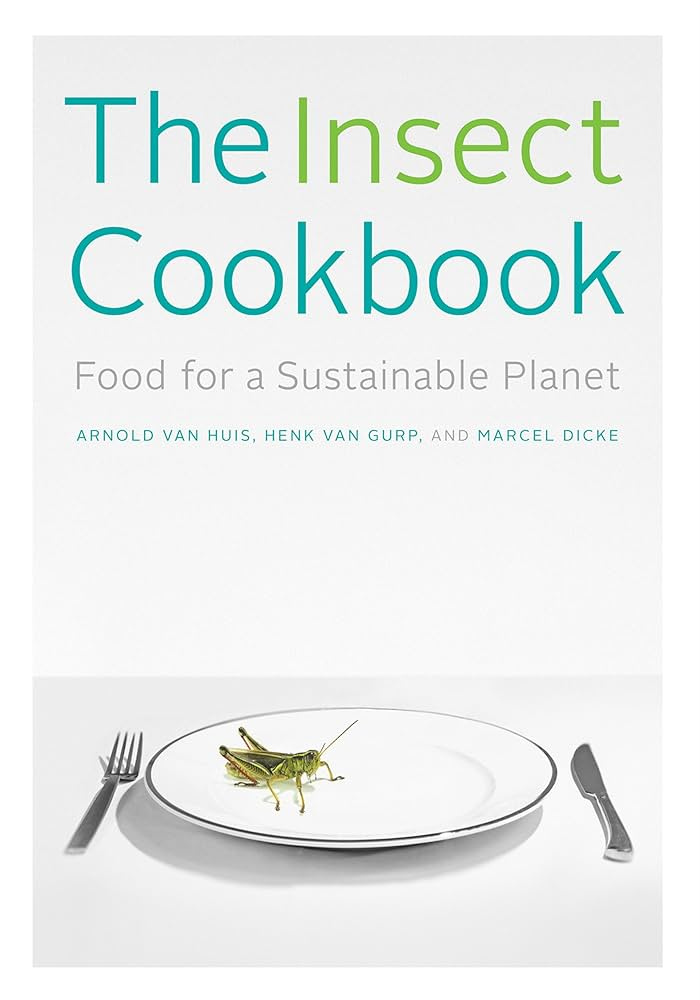
- Van Huis, A., H. van Gurp and M. Dicke, 2014 The Insect cookbook. Columbia University Press, New York.
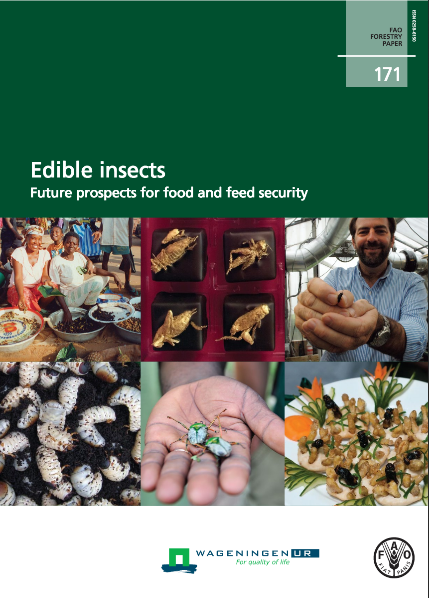
- Van Huis, A., J. Van Itterbeeck, H. Klunder, E. Mertens, A. Halloran, G. Muir, and P. Vantomme, 2013. Edible insects: future prospects for food and feed security FAO Forestry Paper 171. Rome, Food and Agriculture Organization of the United Nations, Rome and Wageningen University and Research Centre, the Netherlands. Downloads 7 million and translated in Chinese, French and Korean.
- Van Huis, A., H. van Gurp, and M. Dicke, 2012. Het insectenkookboek (The Insect Cookbook). Atlas, Amsterdam. 190 pp.
Book chapters
- Dunkel, F.V. and A. van Huis, 2024. Chapter 25 – Edible Insects: a Neglected and Promising Food Source In: Sustainable Protein Sources (Second Edition) (Eds.: S. Nadathur, J. P. D. Wanasundara and L. Scanlin). Academic Press 2024, pp. 515-537. DOI https://doi.org/10.1016/B978-0-323-91652-3.00036-8
- Van Huis, A. Importance of insects as food in Africa. In: (A. Adam Mariod, ed.) African edible insects as alternative source of food, oil, protein and bioactive components”. Cham, Springer International Publishing, pp. 1-17.
- Dicke, M., A. van Huis, J. van Loon., 2020. Insecten: voedzaam en duurzaam. In: 10 miljard monden: Hoe we de wereld gaan voeden in 2050. In: Ingrid de Zwarte and Jeroen Candel (eds.), pp. 317-323. Prometheus, Amsterdam. 384 pp.
- Van Huis, A., 2020. Edible Insects. In: Meiselman, H.L.E. (Ed.) Chapter 46. Handbook of Eating and Drinking: Interdisciplinary Perspectives, pp. 965-980. Springer, Rockport.
- Van Huis, A., 2019. Preface. In: Draft EU guide on good hygiene and practices for producers of insects as food & feed. Brussels: International Platform of Insects for Food and Feed (IPIFF).
- Van Huis, A., 2018. Chapter 11. Insects as human food. In : Ethnozoology: Animals in Our Lives (Eds.: Alves Rômulo Ulysses Paulino de Albuquerque), pp. 195-213. Elsevier, Amsterdam.
- Van Huis, A., 2016. Préface. In: Savoureux insectes: d’aliment traditionnel à l’innovation gastronomique (Eds.: Elisabeth Motte-Flora and Philippe Le Gall), pp. 7-10. Presses Universitaires, Rennes.
- Van Huis, A., 2017. Insects, the new food? In: Science meets Comics (Eds: Reinhold Leinfelder, Alexandra Hamann, Jens Kirstein, Marc Schleunitz), pp. 78-87. Proceedings of the Symposium on Communicating and Designing the Future of Food in the Anthropocene. Ch.A. Bachmann Verlag, Berlin.
- Van Huis, A., 2017. Chapter 17 – New Sources of Animal Proteins: Edible Insects. In: New Aspects of Meat Quality (Ed: Peter P. Purslow), pp. 443–461. Woodhead Publishing. https://doi.org/10.1016/B978-0-08-100593-4.00018-7
- Van Huis, A. and F.V. Dunkel, 2016. Edible insects: a neglected and promising food source. In: Sustainable Protein Sources (Eds.: Sudarshan R. Nadathur, Givaudan Flavors, Janitha P. D. Wanasundara, and Laurie Scanlin), pp. 341-355. Elsevier, Amsterdam.
- Yen, A., Y. Hanboonsong, and A. van Huis, 2012. The role of edible insects in human recreation and tourism. In: The management of insects in recreation and tourism (Ed.: Raynald Harvey Lemelin), pp. 169-185. Cambridge University Press, Cambridge.
- Van Huis, A, 2005. Insects eaten in Africa (Coleoptera, Hymenoptera, Diptera, Heteroptera, Homoptera). In: Ecological implications of mini-livestock: potential of insects, rodents, frogs and snails (Eds.: M.G. Paoletti), p. 231-244. Science Publisher, Inc., Enfield & Plymouth. 648 pp.
- Tchibozo, A. van Huis, and M.G. Paoletti. Notes on edible insects of south Benin: a source of protein. In: Ecological implications of mini-livestock: potential of insects, rodents, frogs and snails (Eds.: M.G. Paoletti), p. 245-250. Science Publisher, Inc., Enfield & Plymouth. 648 pp.
- Van Huis, A., 2003. Medical and stimulating properties ascribed to arthropods and their products in sub-Saharan Africa. In: “Insects in oral literature and traditions” (Eds: Élisabeth Motte-Florac and Jacqueline M.C. Thomas), pp. 367-382. Ethnosciences: 11. Société d’études linguistiques et anthropologiques de France (Series): 407. Peeters, Paris. 633 pp.
Non-refereed
- Van Huis, A. et al (2018). The emerging Insect industry: Invertebrates as production animals. Council for Animal Affairs. https://english.rda.nl/publications/publications/2018/09/03/the-emerging-insect-industry
- Dicke M. and A. van Huis, 2015. Six legged protein. Oxygen, 26: 68-71.
- Van Huis, A. (2014) Insecten als Nahrung für die Welt. In: Lebensmittelsicherheit und Globalisierung – Herausforderungen and Chancen, Bundusinstitut für Risikobewertung Stakeholderconferenz, 2 und 3 June 2014.
- Van Huis, A and M. Dicke, 2014. Insecten eten is gezond en nodig. Gereformeerd dagblad (Nov. 2014).
- Van Huis, A, 2014. Insects to feed the world. Environment and Development Al-Bia Wal-Tanmia, a Leading Arabic Environment Magazine (07/04/2014).
- Hakman, A., M. Peters en A. van Huis, 2013. Toelatingsprocedure voor insecten als minivee: voor het plaatsen van Nieuwe insectensoorten op de lijst voor productie te houden dieren. Laboratorium voor Entomologie, Wageningen Universiteit. 37 pp.