
Table of Contents
ToggleIntegrated pest management of maize in Nicaragua
Introduction
My PhD thesis (can be found here) consists of 220 pages — a thick volume full of graphs, tables, statistics, and complicated calculations. About eighty copies were printed as a dissertation and another two thousand as a publication of Wageningen Agricultural University. I distributed those throughout Latin America. Looking back, I would have preferred to publish the work as separate scientific papers, because the layout of that Wageningen series was certainly not a masterpiece of clarity. However, these days publishing it as a booklet was normal.
Yet the entire story really comes down to a few surprising discoveries that I made during five years of field research in Nicaragua, together with three local assistants and a group of students. I needed another two years to carry out all the statistical analyses and write everything up.
It all began with two enemies of maize.
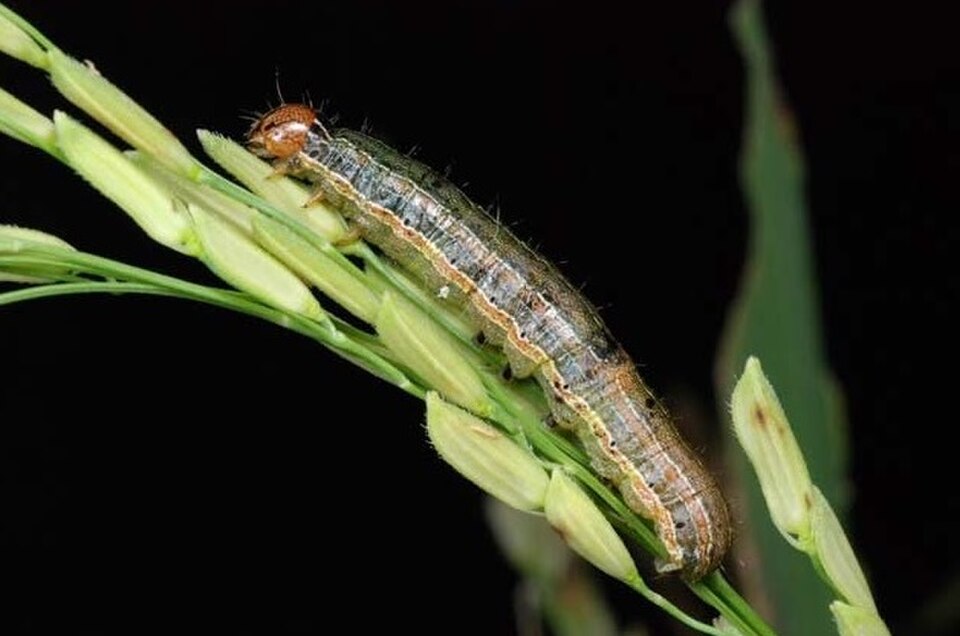
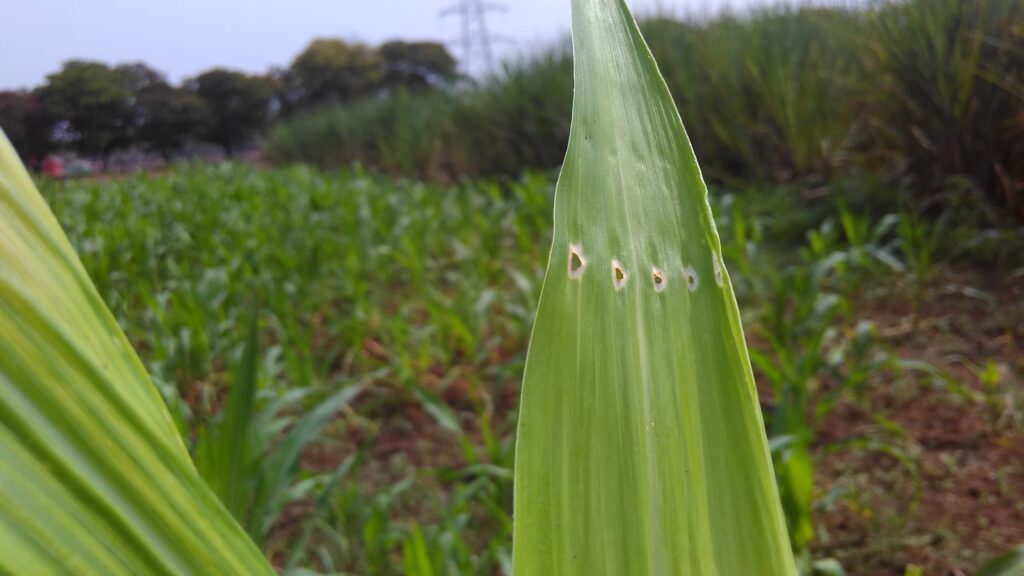
The first was Spodoptera frugiperda, better known as the fall armyworm, or in Spanish “Cogollero”. A voracious caterpillar that hides deep inside the whorl of the maize plant and feeds on the young leaves. Decades later, this insect would invade Africa and Asia and become infamous worldwide.
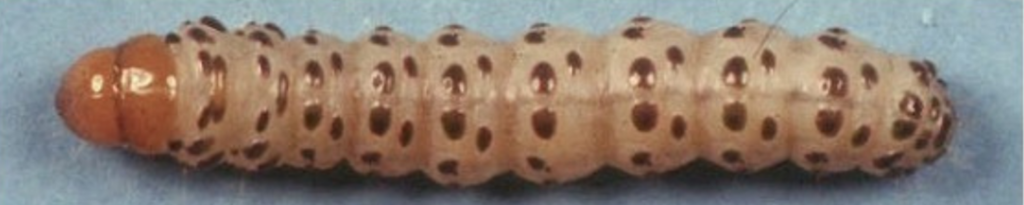
The second pest was Diatraea lineolata, a stem borer. This caterpillar operates far more secretly: it bores into the stem and eats the plant from the inside.
A Completely Different View of Natural Enemies
When I started as a student, I did not really believe in the importance of natural enemies. I thought: how could a few parasitic wasps or predatory insects possibly control a serious pest?
Nicaragua completely changed my perspective.
For the leaf-feeding caterpillar alone, I found fifteen species of parasitoids, three fungi, and twenty-four predators. Parasitoids are insects such as parasitic wasps that lay their eggs inside a caterpillar. The wasp larvae then slowly consume the caterpillar from within — a horror film on an insect scale.
What was remarkable, however, was that you almost never saw these natural enemies.
To discover parasitoids, we had to collect caterpillars from the field and rear them in small containers. Then we waited. Sometimes a moth emerged, but at other times a parasitic wasp appeared instead. That moment never ceased to fascinate me.
Predators were even harder to observe. During the day, for example, earwigs could be found quietly hiding in the leaf axils of maize plants. Nothing unusual. But at night they became active hunters, devouring eggs and young caterpillars. We could only demonstrate this by growing infested plants in cages, with and without earwigs.
The most impressive natural enemy, however, was a nematode — a parasitic roundworm up to thirty centimeters long. If you carefully turned a caterpillar onto its back, you could sometimes see the worm coiled up inside its body. In the interior of Nicaragua, this parasite occasionally killed ninety percent of all caterpillars.
Along the western coast, however, it was almost completely absent. That was no coincidence. In the cotton-growing regions, farmers widely used carbofuran, a powerful nematicide. The pesticide killed not only harmful organisms, but also the farmer’s natural allies.
Gradually, I began to understand an important principle: if nature is allowed to do its work, pests are often kept surprisingly well under control. But as soon as pesticides are applied, the natural enemies usually die first. The pest insects are safely hidden — deep inside the whorl of the plant or inside the stem — whereas the natural enemies constantly move around searching for prey or hosts and are therefore much more exposed to pesticides.
That was perhaps the most important lesson Nicaragua taught me. Yet it is difficult to convince farmers of this. The pest is immediately visible. The natural enemies work invisibly.
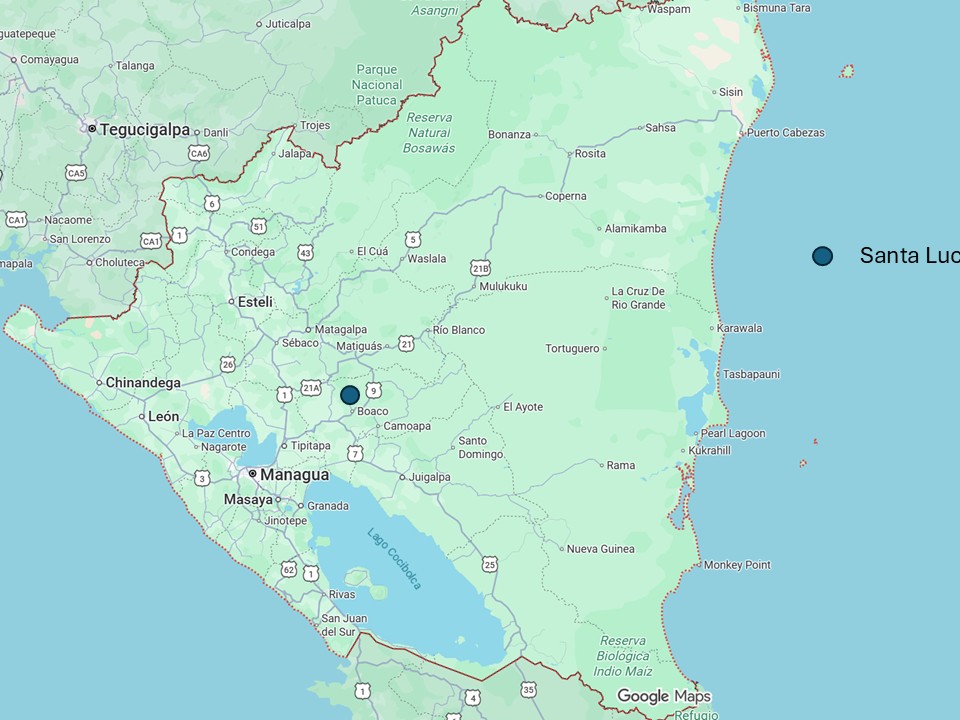
Fig. N4. The map of Nicaragua.
Near Boaco, the site of the field experiment in Santa Lucia, where maize was intercropped with beans to study the effect on pest occurrence. About 100 km northwest of Managua, Leon is situated, where at the university, I taught students about integrated pest management.
Can a Harmful Caterpillar Sometimes Be Beneficial?
During my stay, I regularly gave evening lectures at the University of León, one hundred kilometers north of Managua. On the drive back, at sunset, I often came up with ideas for new experiments. Such inspiration lasts only a few seconds. Proving the idea can take months.
One evening I wondered: what if a plant under drought stress actually benefits from having less leaf area? Less leaf area means less evaporation. Could a leaf-feeding caterpillar perhaps even be beneficial under dry conditions?
That sounded almost heretical.
But Nicaragua has a distinct dry season, and with irrigation we could regulate soil moisture precisely. The experiment was therefore feasible.
The results were astonishing. Under dry conditions, damaged plants actually grew better than undamaged plants. Under adequate moisture, the caterpillar reduced yield by half, but during drought it had virtually no negative effect.
So the theory proved correct.
Years later, I observed the same mechanism in Niger. After good rainfall and fertilization, some fields looked magnificent. But as soon as drought began, the heavily fertilized plants died first. They simply had too much leaf area and lost too much water.
More Damage, Higher Yield?
Things became even stranger with the stem borer.
In a large experiment, I compared different levels of infestation. Later, when I plotted the number of damaged internodes against the weight of the maize ears, I was astonished to find a positive relationship.
More damage appeared to mean higher yield.
That could not possibly be true.
I started calculating again. With the help of statistician Marius Keuls — later famous for the Student-Newman-Keuls test — I made complex corrections for differences between large and small plants.
Then everything suddenly made sense.
Large plants simply produced higher yields and at the same time attracted more moths. As a result, they suffered more infestation and more damage. The damage itself did not cause the higher yield; both were consequences of larger plants.
After correction, each stem borer turned out to reduce yield by about three to six percent.
Sometimes statistics can completely mislead you.
Beans as Natural Protection
In Nicaragua, farmers often plant beans between rows of maize. We decided to test this system on a large scale over several hectares of farmland.
The results were impressive.
Fields with beans planted between maize rows produced higher yields than pure monocultures. Moreover, damage from the leaf-feeding caterpillar decreased by twenty to thirty percent.
The explanation was probably the following: after hatching, young caterpillars disperse by wind. When bean plants are present between the maize rows, many caterpillars land on the beans instead of on maize — and subsequently die.
Stem borer infestation also decreased. Presumably, the moths had greater difficulty locating maize plants in the mixed cropping system.
Without calling it that, farmers were already practicing a form of integrated pest management.
Young Maize Can Tolerate Remarkable Damage
One of our final experiments was almost childishly simple. Every day we cut small pieces from the leaves of young maize plants to determine at what stage damage actually affected yield.
To our surprise, damage during the first two to three weeks after emergence had almost no effect at all. Young plants could be almost completely defoliated — or even cut back to ground level — without any yield loss.
This had previously been observed in the United States as well. Insurance companies wanted to know whether farmers should be compensated for hail damage. In young maize, compensation was usually unnecessary.
Later I saw the same phenomenon in East Africa. An armyworm outbreak could completely strip a young maize field bare, after which the plants simply recovered.
Nature often proves far more resilient than we imagine.
Epilogue
Looking back now on those years in Nicaragua, I realize that the research taught me at least as much as it taught the students who worked with me. I left as a young researcher with great confidence in modern agricultural methods. I returned with a deep respect for the complexity of nature.
What struck me most was how little we actually see of what truly happens in an agricultural field. Beneath every leaf, inside every stem, and even within the body of a caterpillar, there exists a hidden world of attack, defense, cooperation, and balance. A world in which parasitic wasps, earwigs, fungi, and nematodes often prove more effective than pesticides.
That experience strongly influenced my later work. Not only in Latin America, but later also in Africa, I repeatedly saw the same pattern: when farmers try to dominate nature completely through pesticides, fertilizers, or monocultures, new problems often arise. But when they work together with natural processes, resilience emerges.
Some of the results from Nicaragua seemed almost unbelievable at the time. A harmful caterpillar causing no damage under drought conditions. A stem borer whose damage initially appeared associated with higher yields. Young maize plants that could be completely defoliated without loss. Yet reality turned out to be more complicated — and far more interesting — than the simple assumptions with which we often begin.
Science therefore consists not only of measuring and calculating. Above all, it begins with curiosity. With careful observation. With questioning what appears self-evident.
And perhaps that was the most important lesson Nicaragua taught me: not that humans fully understand or control nature, but that nature is often organized far more intelligently than we realize.